数据结构与算法全景指南:从原理到 TS 实现
December 27, 2025 (9mo ago)
参考来自 hello-algo,浙大数据结构课程,个人实验场 React-TS-Demo - StackBlitz
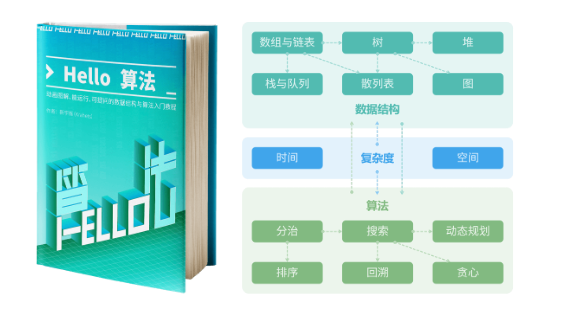
前言
若你是算法初学者,从未接触过算法,或者已经有一些刷题经验,对数据结构与算法有模糊的认识,在会与不会之间反复横跳。
下面的大纲内容
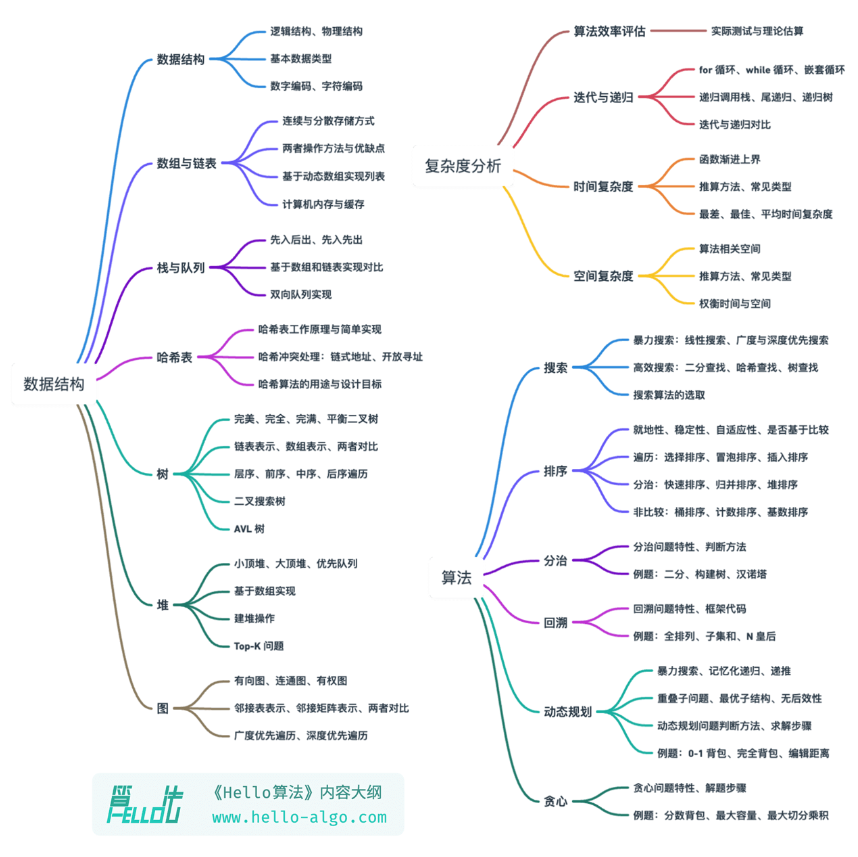
主打三个方面
- 前置概念 -算法的度量标准
- 相关的数据结构
- 具体的算法介绍和说明
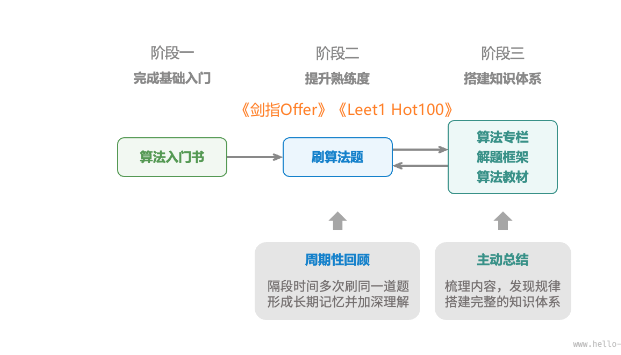
对于如何学习算法这件事
- 阶段一:算法入门。我们需要熟悉各种数据结构的特点和用法,学习不同算法的原理、流程、用途和效率等方面的内容。
- 阶段二:刷算法题。建议从热门题目开刷,如“剑指 Offer”和“LeetCode Hot 100”,先积累至少 100 道题目,熟悉主流的算法问题。初次刷题时,“知识遗忘”可能是一个挑战,但请放心,这是很正常的。我们可以按照“艾宾浩斯遗忘曲线”来复习题目,通常在进行 3~5 轮的重复后,就能将其牢记在心。
- 阶段三:搭建知识体系。在学习方面,我们可以阅读算法专栏文章、解题框架和算法教材,以不断丰富知识体系。在刷题方面,可以尝试采用进阶刷题策略,如按专题分类、一题多解、一解多题等,相关的刷题心得可以在各个社区找到。
初识算法
算法无处不在 比如:
- 查字典的二分查找
- 扑克牌的排序
- 货币找零
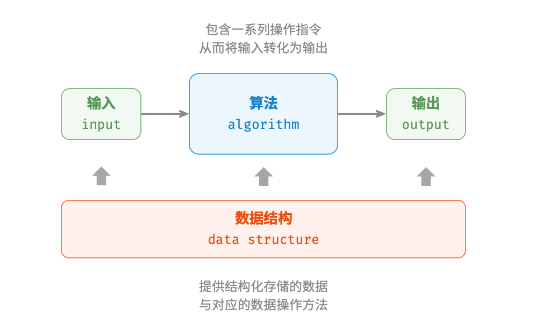
算法和数据结构:
算法是指能够在有限时间内解决特定问题的一系列步骤,特征如下
- 问题是明确的,包含清晰的输入和输出定义。
- 具有可行性,能够在有限步骤、时间和内存空间下完成。
- 各步骤都有确定的含义,在相同的输入和运行条件下,输出始终相同。
数据结构:
是计算机中存储数据的方式,具有如下的设计目标
- 空间占用尽量少,以节省计算机内存。
- 数据操作尽可能快速,涵盖数据访问、添加、删除、更新等。
- 提供简洁的数据表示和逻辑信息,以便算法高效运行。
数据结构设计是一个充满权衡的过程。如果想在某方面取得提升,往往需要在另一方面作出妥协。平衡 是关键
算法和数据结构的关系:
- 数据结构是算法的基石。
- 算法是数据结构发挥作用的舞台。
- 算法通常可以基于不同的数据结构实现,但执行效率可能相差很大,选择合适的数据结构是关键。
关于算法的度量
我们先后追求两个重要目标:
- 找到问题的解法
- 找到问题的最优解法(效率)
- 时间效率(运行时间)
- 空间效率(占用内存)
我们用实际的运行来看,容易受到各种条件的限制 比如设备性能什么的。所以我们采取 理论估算的方式来描述算法的效率。
它有两个概念:时间复杂度 & 空间复杂度
循环和递归
循环有两个for 和while ,for易用与 条件已知的循环,while更加的灵活。它们与输入的数据的量 n 在时间上成线性关系。
递归 包含两个阶段 递/归。
- 递:程序不断深入地调用自身,通常传入更小或更简化的参数,直到达到“终止条件”
- 归:触发“终止条件”后,程序从最深层的递归函数开始逐层返回,汇聚每一层的结果。
三个要素:终止条件,递归调用,返回结果。
除此外 递归算法还有分类
- 普通递归 比如说递归求和 求和的是在 归的过程中完成的 ,每层都要执行一次求和操作
- 尾递归 比如说递归求和 求和的过程是在 递 中完成的,归只需要返回。
下面是一个最简单的斐波那契额算法
给定一个斐波那契数列 0,1,1,2,3,5,8,13,… ,求该数列的第 n 个数字。
斐波那契
/* 斐波那契数列:递归 */
function fib(n: number): number {
    // 终止条件 f(1) = 0, f(2) = 1
    if (n === 1 || n === 2) return n - 1;
    // 递归调用 f(n) = f(n-1) + f(n-2)
    const res = fib(n - 1) + fib(n - 2);
    // 返回结果 f(n)
    return res;
}
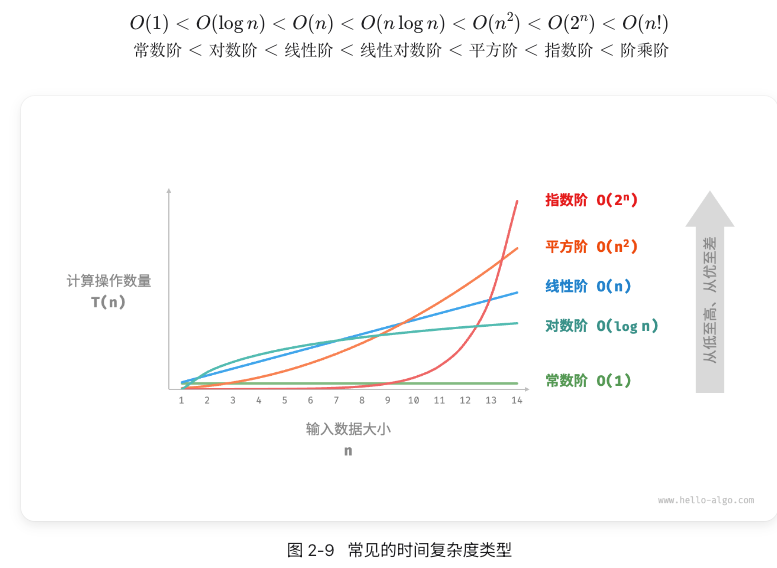
具体的时间复杂度
下面给出了常见的时间复杂度
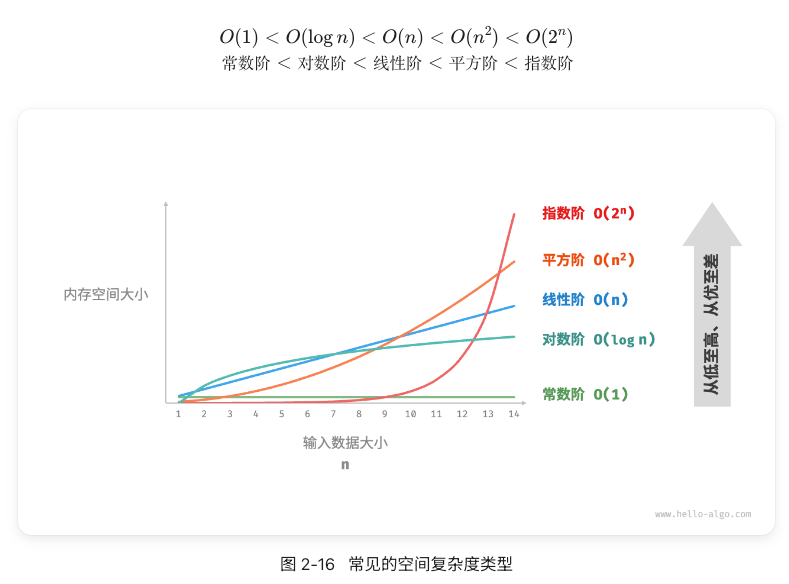
具体的空间复杂度
下面给出了具体的空间浮渣度
相关的问题
Q: 尾递归空间复杂度是 O(1) ?
A: 理论上是可以优化到 O(1) ,但是大部分编程语言 不支持自动优化尾递归,我们认为它是 O(n)
数据结构
分类
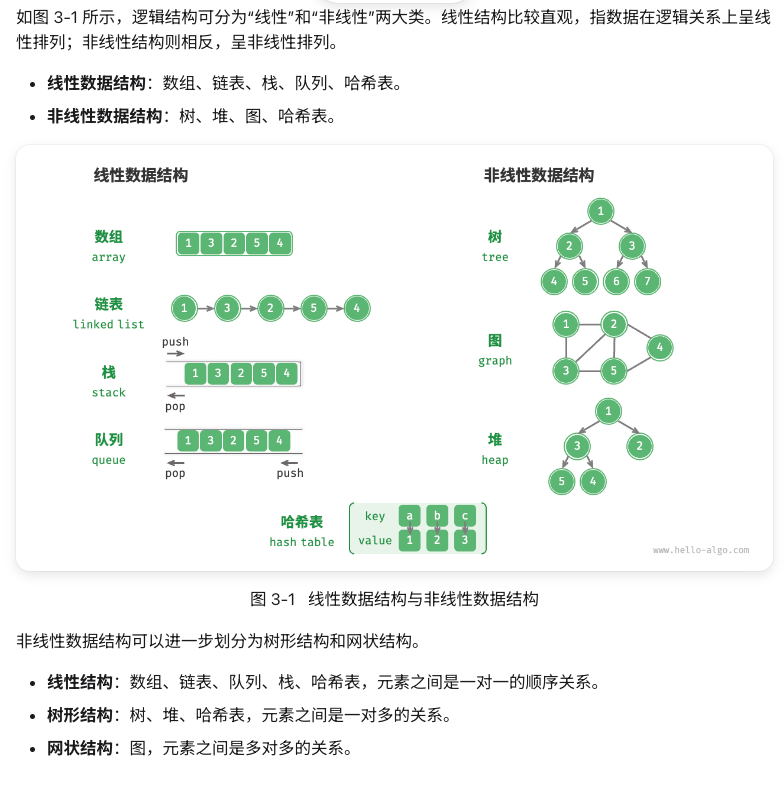
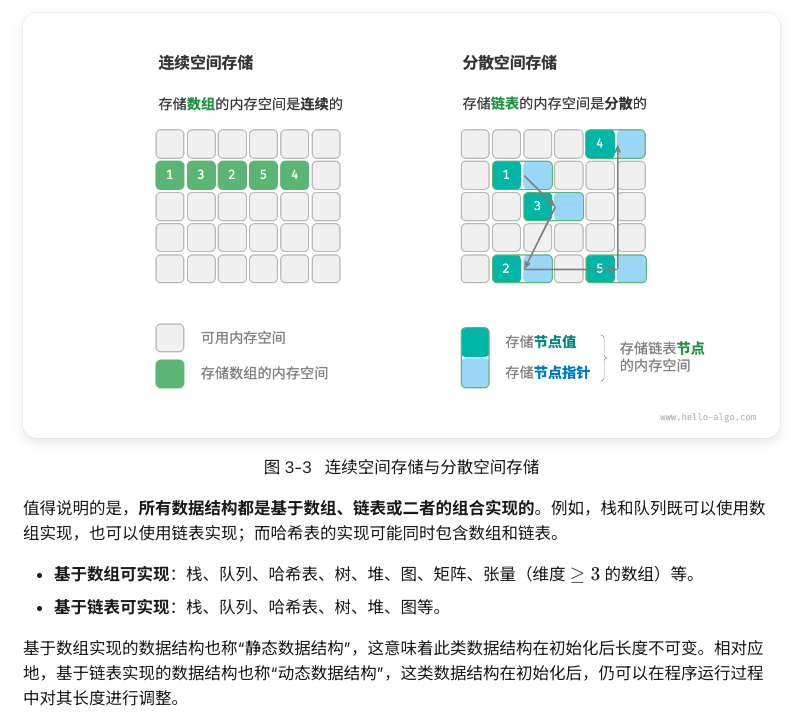
然后说物理学上的分类:连续存储空间和 非连续存储空间
数据结构分析开始
数组和链表
对于Array
对于Array来说,它是存储在一片连续的存储空间中的
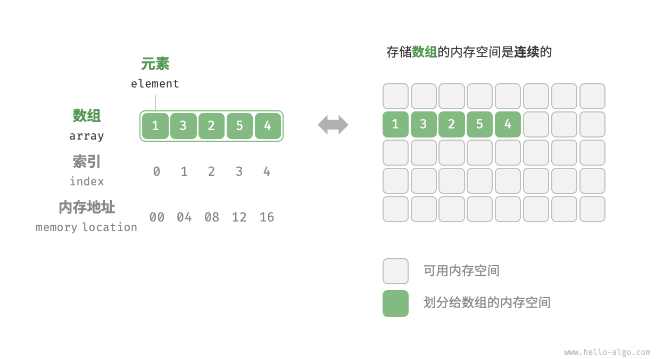
由于语言基本上是对Array 提供默认的操作,所以我们不需要额外的实现它。
需要了解的是Array在算法上的一些特性:
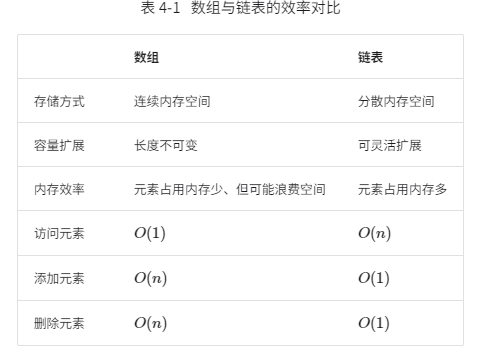
对于删除和插入元素而言 :插入和删除的时间复杂度为 O(n) 其中 n 为数组长度。
由于数组的长度不可变,因此在插入元素后,超出数组长度范围的元素会丢失。
我们可以初始化一个比较长的数组,只用前面一部分,这样在插入数据时,丢失的末尾元素都是“无意义”的,但这样做会造成部分内存空间浪费。
在大多数的语言实现中 array多数的可变长的。但是要注意的是它的扩容 时间复杂度也是 O(n)
不过呢 它的元素访问的时间复杂度却是高效的 O(1),
Array这种结构经常用在下面额几种算法场景
- 元素的随机访问
- 排序和搜索
- 查找表
- 机器学习,矩阵运算什么的用它
- 其它数据结构的实现,stack,queue hashtabe,map都可以基于它实现
链表
链表的重要属性:当前的值value 和指向下一个node 的指针。它在内存空间的存储是非连续性的。在相同数据量的情况下:链表比数组占用更多的内存空间。
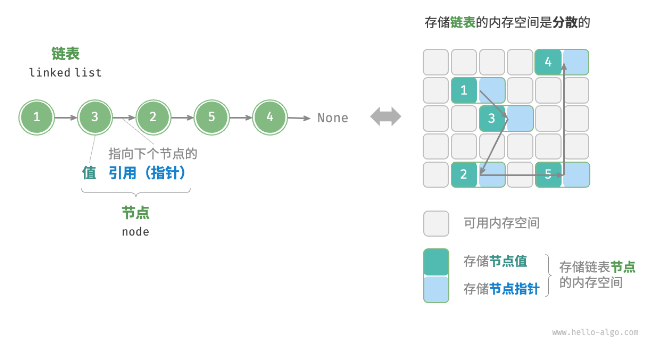
// 一个链表 ListNode节点
class ListNode {
  val: number;
  next: ListNode | null;

  constructor(val?: number, next?: ListNode | null) {
    this.val = val || 0;
    this.next = next || null;
  }
}

// 一个双向链表Class (具备前后指针)
class ListNodeS {
  val: number;
  next: ListNodeS | null;
  pre: ListNodeS | null;

  constructor(val?: number, next?: ListNodeS | null, pre?: ListNodeS | null) {
    this.val = val || 0;
    this.next = next || null;
    this.pre = pre || null;
  }
}

const run = () => {
  // 创建一个list 1 -> 3 -> 2 -> 5 -> 4 */
  const n0 = new ListNode(1);
  const n1 = new ListNode(3);
  const n2 = new ListNode(2);
  const n3 = new ListNode(5);
  const n4 = new ListNode(4);

  n0.next = n1;
  n1.next = n2;
  n2.next = n3;
  n3.next = n4;
  console.log(n0);

  // 插入一个节点 就是改变其指针 (在n0 后插入 p)
  const insert = (n0: ListNode, P: ListNode): void => {
    const n1 = n0.next;
    P.next = n1;
    n0.next = P;
  };

  // 删除 就是吧某个指针设置为null
  const remove = (n0: ListNode): void => {
    if (!n0.next) return;

    const P = n0.next;
    const n1 = P.next;
    n0.next = n1;
  };

  // 访问索引 为index的节点
  const access = (head: ListNode | null, index: number): ListNode | null => {
    for (let i = 0; i < index; i++) {
      if (!head) return null;
      head = head.next;
    }
    return head;
  };

  // 查找某个元素
  const find = (head: ListNode | null, target: number): number => {
    let idx = 0;
    while (head != null) {
      if (head.val === target) {
        return idx;
      }
      head = head.next;
      idx += 1;
    }
    return -1;
  };

  console.log('find--->', find(n0, 4));
};

export { run };
链表还有三种类型:单向(最后一个节点指针指向None),环形(任意节点都可以视作头),双向(这个类型的比较吊).
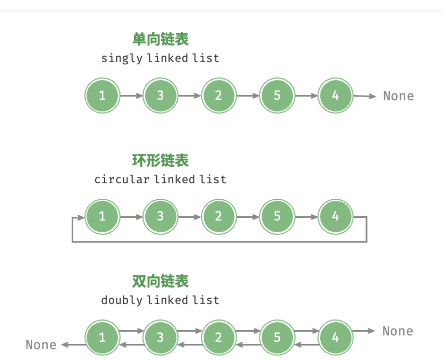
我们可以重点关注一下 双向链表: 它更具灵活性,可以朝两个方向遍历链表,但相应地也需要占用更多的内存空间。
/* 双向链表节点类 */
class ListNode {
    val: number;
    next: ListNode | null;
    prev: ListNode | null;
    constructor(val?: number, next?: ListNode | null, prev?: ListNode | null) {
        this.val = val  ===  undefined ? 0 : val;        // 节点值
        this.next = next  ===  undefined ? null : next;  // 指向后继节点的引用
        this.prev = prev  ===  undefined ? null : prev;  // 指向前驱节点的引用
    }
}
通常链表可以有下面的应用
| 当向链表 | 双向链表 | 环形链表 |
|---|---|---|
| 栈与队列,哈希表(hash冲突的链表解决方案),图实现 | 红黑树,B+树,浏览器历史 | 缓冲区实现,时间片的轮训调度(CPU) |
一个小型列表的实现
/* 列表类 */
class MyList {
    private arr: Array<number>; // 数组(存储列表元素)
    private _capacity: number = 10; // 列表容量
    private _size: number = 0; // 列表长度(当前元素数量)
    private extendRatio: number = 2; // 每次列表扩容的倍数

    /* 构造方法 */
    constructor() {
        this.arr = new Array(this._capacity);
    }

    /* 获取列表长度(当前元素数量)*/
    public size(): number {
        return this._size;
    }

    /* 获取列表容量 */
    public capacity(): number {
        return this._capacity;
    }

    /* 访问元素 */
    public get(index: number): number {
        // 索引如果越界,则抛出异常,下同
        if (index < 0 || index >= this._size) throw new Error('索引越界');
        return this.arr[index];
    }

    /* 更新元素 */
    public set(index: number, num: number): void {
        if (index < 0 || index >= this._size) throw new Error('索引越界');
        this.arr[index] = num;
    }

    /* 在尾部添加元素 */
    public add(num: number): void {
        // 如果长度等于容量,则需要扩容
        if (this._size === this._capacity) this.extendCapacity();
        // 将新元素添加到列表尾部
        this.arr[this._size] = num;
        this._size++;
    }

    /* 在中间插入元素 */
    public insert(index: number, num: number): void {
        if (index < 0 || index >= this._size) throw new Error('索引越界');
        // 元素数量超出容量时,触发扩容机制
        if (this._size === this._capacity) {
            this.extendCapacity();
        }
        // 将索引 index 以及之后的元素都向后移动一位
        for (let j = this._size - 1; j >= index; j--) {
            this.arr[j + 1] = this.arr[j];
        }
        // 更新元素数量
        this.arr[index] = num;
        this._size++;
    }

    /* 删除元素 */
    public remove(index: number): number {
        if (index < 0 || index >= this._size) throw new Error('索引越界');
        let num = this.arr[index];
        // 将索引 index 之后的元素都向前移动一位
        for (let j = index; j < this._size - 1; j++) {
            this.arr[j] = this.arr[j + 1];
        }
        // 更新元素数量
        this._size--;
        // 返回被删除的元素
        return num;
    }

    /* 列表扩容 */
    public extendCapacity(): void {
        // 新建一个长度为 size 的数组,并将原数组复制到新数组
        this.arr = this.arr.concat(
            new Array(this.capacity() * (this.extendRatio - 1))
        );
        // 更新列表容量
        this._capacity = this.arr.length;
    }

    /* 将列表转换为数组 */
    public toArray(): number[] {
        let size = this.size();
        // 仅转换有效长度范围内的列表元素
        const arr = new Array(size);
        for (let i = 0; i < size; i++) {
            arr[i] = this.get(i);
        }
        return arr;
    }
}
它的一些算法上的特性:
元素的访问由于基于Array实现它的时间复杂度为O(1), 插入删除效率为O(n) 同Array
栈与队列
stack
先进后出的策略;概念:入栈 ,出栈,栈顶/底。其算法上的特征
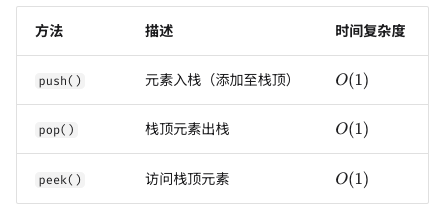
栈 可以基于两种数据结构实现 (链表/数组)。
class LinkedListStatck {
  private stackPeek: ListNode | null; // 栈顶
  private stkSize: number = 0;

  constructor() {
    this.stackPeek = null;
  }

  get size(): number {
    return this.stkSize;
  }

  isEmpty(): boolean {
    return this.size === 0;
  }

  push(val: number): void {
    const node = new ListNode(val);
    node.next = this.stackPeek;
    this.stackPeek = node; // 环形
    this.stkSize++;
  }

  pop(): number {
    const val = this.peek();
    this.stackPeek = this.stackPeek.next;
    this.stkSize--;
    return val;
  }

  // 访问栈顶
  peek(): number {
    return this.stackPeek.val;
  }

  // 转Arry
  toArray(): Array<number> {
    let node = this.stackPeek;
    const res = new Array<number>(this.size);
    for (let i = res.length - 1; i >= 0; i--) {
      res[i] = node.val;
      node = node.next;
    }
    return res;
  }
}
// 基于Array的实现 这个就非常的简单了 Arrry本身就具备Stack的部分特征
class ArrayStack {
  private stack: Array<number>;

  constructor() {
    this.stack = [];
  }

  get size(): number {
    return this.stack.length;
  }

  isEmpyt() {
    return this.stack.length === 0;
  }

  push(val: number) {
    this.stack.push(val);
  }

  pop() {
    this.stack.pop();
  }

  peek() {
    return this.stack[this.stack.length - 1];
  }

  toArray() {
    return this.stack;
  }
}
两种不同的实现的特效对比(时间/空间)
- 基于数组实现的栈在触发扩容时效率会降低,但由于扩容是低频操作,因此平均效率更高。
- 基于链表实现的栈可以提供更加稳定的效率表现。
链表节点占用的空间相对较大。
queue
先进先出,轮流来 就像水一样。它也是可以基于两种情况来实现:链表/数组。
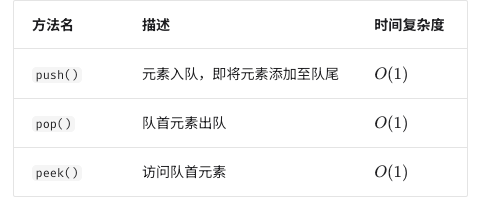
基于链表的实现还是简单的些的,但是基于Array的还是有点困难的 见下面的代码
// 基于链表实现的queue
class LinkedListQueue {
  private front: ListNode|null; // 头尾节点
  private rear:ListNode|null;
  private queSize:number=0;

  constructor(){
    this.front = null;
    this.rear = null;
  }

  get size(){
    return this.size;
  }

  isEmpty(){
    return this.size === 0;
  }

  push(val:number){
    const node = new ListNode(val);
    // 如果为空
    if(!this.front){
      this.front = node;
      this.rear=node;
    }else{
      this.rear!.next = node;
      this.rear = node;
    }
    // 否则
    this.queSize++
  }

  pop(){
    const val = this.peek();

    // 直接移动指针
    this.front = this.front.next;
    this.queSize--

    return val;
  }

  peek(){
    return this.front!.val
  }

  toArrray(){
    let node = this.front
    const res = new Array(this.size)
    for( let i = 0; i< res.length; i++ ){
      res[i] = node.val;
      node = node.next;
    }
    return res
  }

}
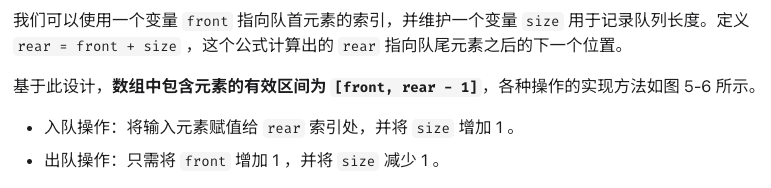
这里为什么要做复杂设计呢?主要是由于Array的删除首元素的时间复杂度是O(n), 我们要想办法优化它

/* 基于环形数组实现的队列 */
class ArrayQueue {
    private nums: number[]; // 用于存储队列元素的数组
    private front: number; // 队首指针,指向队首元素
    private queSize: number; // 队列长度

    constructor(capacity: number) {
        this.nums = new Array(capacity);
        this.front = this.queSize = 0;
    }

    /* 获取队列的容量 */
    get capacity(): number {
        return this.nums.length;
    }

    /* 获取队列的长度 */
    get size(): number {
        return this.queSize;
    }

    /* 判断队列是否为空 */
    isEmpty(): boolean {
        return this.queSize === 0;
    }

    /* 入队 */
    push(num: number): void {
        if (this.size === this.capacity) {
            console.log('队列已满');
            return;
        }
        // 计算队尾指针,指向队尾索引 + 1
        // 通过取余操作实现 rear 越过数组尾部后回到头部
        const rear = (this.front + this.queSize) % this.capacity;
        // 将 num 添加至队尾
        this.nums[rear] = num;
        this.queSize++;
    }

    /* 出队 */
    pop(): number {
        const num = this.peek();
        // 队首指针向后移动一位,若越过尾部,则返回到数组头部
        this.front = (this.front + 1) % this.capacity;
        this.queSize--;
        return num;
    }

    /* 访问队首元素 */
    peek(): number {
        if (this.isEmpty()) throw new Error('队列为空');
        return this.nums[this.front];
    }

    /* 返回 Array */
    toArray(): number[] {
        // 仅转换有效长度范围内的列表元素
        const arr = new Array(this.size);
        for (let i = 0, j = this.front; i < this.size; i++, j++) {
            arr[i] = this.nums[j % this.capacity];
        }
        return arr;
    }
}(double-ended queue)双向队列
这种数据结构 ,可以可以通过 双向链表/环形数组 来实现。
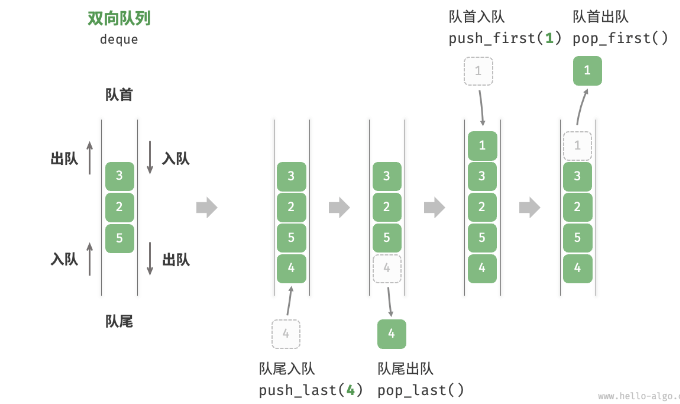
它的算法复杂度特征如下:
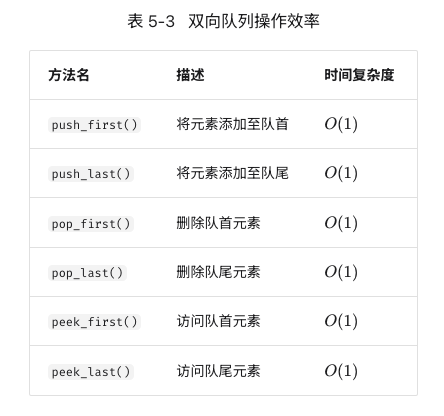
实际上我们可以直接用Array 来做这类数据结构
const deque  = []

// 入队
deque.push(2)
deque.push(5)
deque.push(4)
deque.unshift(3) // 注意这个方法的时间复杂度为 O(n)

// 获取
deque[0]
deque[deque.length-1]

// 出队 shift 的时间复杂为 O(n)
const popFront = deque.shift()
const popBack = deque.pop()
这两种实现方案中,对于Array的实现方法它简单些。
class ListNodeV2 {
  pre: ListNodeV2;
  next: ListNodeV2;
  val: number;
  constructor(val: number) {
    this.val = val;
    this.pre = null;
    this.next = null;
  }
}

class LinkedListDeque {
  private front: ListNodeV2; // 头和尾节点
  private rear: ListNodeV2;
  private queSize: number;

  constructor() {
    this.front = null;
    this.rear = null;
    this.queSize = 0;
  }

  // push 的两个方向
  pushLast(val: number) {
    const node = new ListNodeV2(val);
    if (this.queSize === 0) {
      this.front = node;
      this.rear = node;
    } else {
      // 注意环操作!
      this.rear.next = node;
      node.pre = this.rear;
      this.rear = node;
    }
    this.queSize++;
  }

  pushFirst(val: number) {
    const node = new ListNodeV2(val);
    if (this.queSize == 0) {
      this.front = node;
      this.rear = node;
    } else {
      this.front.pre = node;
      node.next = this.front;
      this.front = node;
    }

    this.queSize++;
  }

  // pop的两个方向
  popLast() {
    const value = this.rear.val;

    let temp = this.rear.pre;
    if (temp) {
      temp.next = null;
      this.rear.pre = null;
    }

    // 尾处理
    this.rear = temp;
    this.queSize--;
    return value;
  }

  popFirts() {
    const value = this.front.val;

    let temp = this.front.next;
    if (temp) {
      temp.next = null;
      this.front.next = null;
    }

    // 尾处理
    this.front = temp;
    this.queSize--;
    return value;
  }
}
/* 基于环形数组实现的双向队列 */
class ArrayDeque {
private nums: number[]; // 用于存储双向队列元素的数组
private front: number; // 队首指针,指向队首元素
private queSize: number; // 双向队列长度
/* 构造方法 */
constructor(capacity: number) {
this.nums = new Array(capacity);
this.front = 0;
this.queSize = 0;
}
/* 获取双向队列的容量 */
capacity(): number {
return this.nums.length;
}
/* 获取双向队列的长度 */
size(): number {
return this.queSize;
}
/* 判断双向队列是否为空 */
isEmpty(): boolean {
return this.queSize === 0;
}
/* 计算环形数组索引 */
index(i: number): number {
// 通过取余操作实现数组首尾相连
// 当 i 越过数组尾部后,回到头部
// 当 i 越过数组头部后,回到尾部
return (i + this.capacity()) % this.capacity();
}
/* 队首入队 */
pushFirst(num: number): void {
if (this.queSize === this.capacity()) {
console.log('双向队列已满');
return;
}
// 队首指针向左移动一位
// 通过取余操作实现 front 越过数组头部后回到尾部
this.front = this.index(this.front - 1);
// 将 num 添加至队首
this.nums[this.front] = num;
this.queSize++;
}
/* 队尾入队 */
pushLast(num: number): void {
if (this.queSize === this.capacity()) {
console.log('双向队列已满');
return;
}
// 计算队尾指针,指向队尾索引 + 1
const rear: number = this.index(this.front + this.queSize);
// 将 num 添加至队尾
this.nums[rear] = num;
this.queSize++;
}
/* 队首出队 */
popFirst(): number {
const num: number = this.peekFirst();
// 队首指针向后移动一位
this.front = this.index(this.front + 1);
this.queSize--;
return num;
}
/* 队尾出队 */
popLast(): number {
const num: number = this.peekLast();
this.queSize--;
return num;
}
/* 访问队首元素 */
peekFirst(): number {
if (this.isEmpty()) throw new Error('The Deque Is Empty.');
return this.nums[this.front];
}
/* 访问队尾元素 */
peekLast(): number {
if (this.isEmpty()) throw new Error('The Deque Is Empty.');
// 计算尾元素索引
const last = this.index(this.front + this.queSize - 1);
return this.nums[last];
}
/* 返回数组用于打印 */
toArray(): number[] {
// 仅转换有效长度范围内的列表元素
const res: number[] = [];
for (let i = 0, j = this.front; i < this.queSize; i++, j++) {
res[i] = this.nums[this.index(j)];
}
return res;
}
}双向队列兼具栈与队列的逻辑,因此它可以实现这两者的所有应用场景,同时提供更高的自由度。
哈希表
概述
hash表,是一种通过建立key value之间的联系 ,以实现高校存储的一种数据结构。在哈希表中进行增删查改的时间复杂度都是 n(1) 非常高效
这种数据结构的算法特征如下:
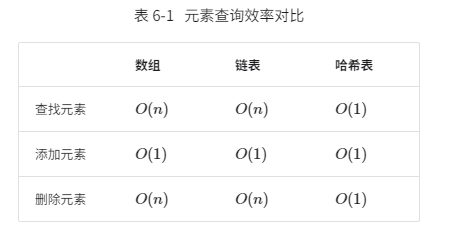
在js中内置了 这样的数据结构:Map
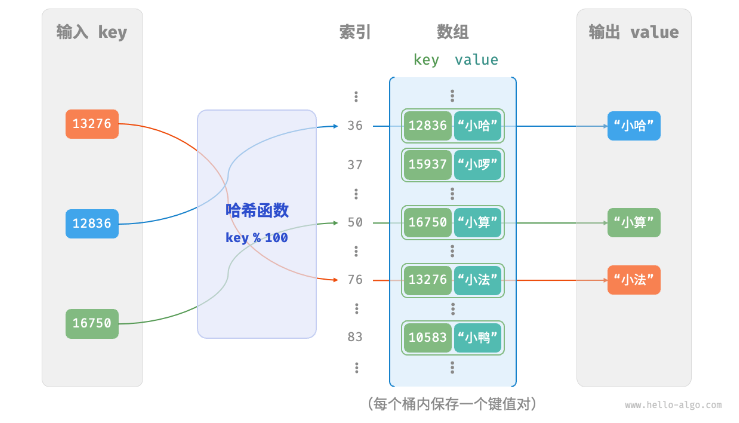
如果模拟 那么hash表的实现比较的简单,我们可以使用array进行一个模拟。核心的重点是两个地方
- 通过某种哈希算法 hash() 计算得到哈希值。
- 将哈希值对桶数量(数组长度)capacity 取模,从而获取该 key 对应的数组索引 index 。
上述的公式如下:
const index = hash(key) % capacity下面是一个简单的示意图 :
数组长度capacity=100,has(key) = key, has functon = k %100,key value 存储了学生学号和姓名
模拟hash表
// 对所有的number -> string

class Pair {
  public key: number;
  public val: number;
  constructor(key: number, val: string){
    this.key = key;
    this.val = val;
  }
}

// 基于Array的实现
class ArrayHashMap {
	private readyonly buckets:(Pari|null)[];

  constructor(){
    this.buckets = new Array(100).fill(null);
  }

  private hasFunc(key: number):number{
    return key % 100;
  }
    /* 查询操作 */
    public get(key: number): string | null {
        let index = this.hashFunc(key);
        let pair = this.buckets[index];
        if (pair === null) return null;
        return pair.val;
    }

    /* 添加操作 */
    public set(key: number, val: string) {
        let index = this.hashFunc(key);
        this.buckets[index] = new Pair(key, val);
    }

    /* 删除操作 */
    public delete(key: number) {
        let index = this.hashFunc(key);
        // 置为 null ,代表删除
        this.buckets[index] = null;
    }
  public entries(){
    let arr;

    for( let i = 0; i < this.buckets.length; i++ ){
      if(this.bukest[i]){
        arr.push(this.this.bukest[i])
      }
    }
    return arr;
  }

 	public keys(): (number | undefined)[] {
    let arr: (number | undefined)[] = [];
    for (let i = 0; i < this.buckets.length; i++) {
        if (this.buckets[i]) {
            arr.push(this.buckets[i].key);
        }
    }
    return arr;
}

  public values() {
    let arr: (string)[] = [];
    for( let i = 0; i < this.buckets.length; i++ ){
      if(this.buckets[i]) {
        arr.push( this.buckets[i].val );
      }
      return arr;
    }
  }

  public print(){
    let pairSet = this.entries();
    for( const pair of pairSet ) {
      console.log(`${pair.key} -> ${pair.value}`)
    }
  }

}
理论上 理论上一定存在“多个输入对应相同输出”的情况。
12836%100=36
20336%100=36
我们可以通过扩容哈希表来减少哈希冲突。
还有一个概念 叫做:“负载因子 load factor”其定义为哈希表的元素数量除以桶数量,用于衡量哈希冲突的严重程度,也常作为哈希表扩容的触发条件。例如在 Java 中,当负载因子超过 0.75 时,系统会将哈希表扩容至原先的 2 倍
hash冲突
保证哈希表可以在发生冲突时正常工作, 是它要解决的问题。
由于 通常情况下哈希函数的输入空间远大于输出空间,因此理论上哈希冲突是不可避免的,所以我们找到了两种方式来优化hash 结构
- 改良哈希表数据结构,使得哈希表可以在出现哈希冲突时正常工作。
- 仅在必要时,即当哈希冲突比较严重时,才执行扩容操作。
主要就是两种方法:链式地址 / 开发寻址
链式寻址
它将单个元素转换为链表,将键值对作为链表节点,将所有发生冲突的键值对都存储在同一链表中。类似下面的图
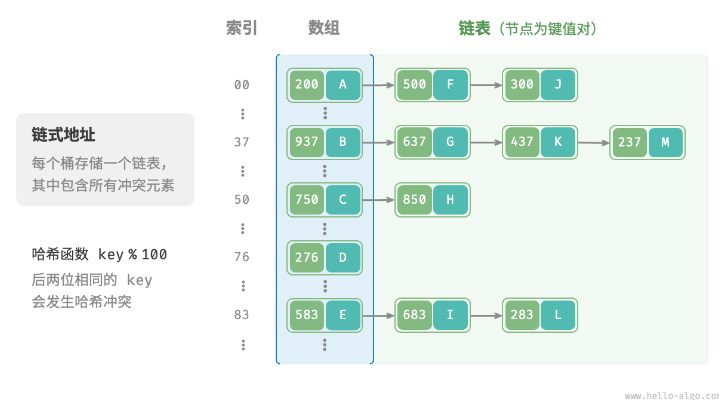
它是有局限性的:
- 占用空间增大:链表包含节点指针,它相比数组更加耗费内存空间。
- 查询效率降低:因为需要线性遍历链表来查找对应元素。
下面我们看看实现:
使用列表(动态数组)代替链表; 达到2/3时扩容2倍
class Pair {
  public key: number;
  public val: number;
  constructor(key: number, val: string){
    this.key = key;
    this.val = val;
  }
}


/* 链式地址哈希表 */
class HashMapChaining {
    #size: number; // 键值对数量
    #capacity: number; // 哈希表容量
    #loadThres: number; // 触发扩容的负载因子阈值
    #extendRatio: number; // 扩容倍数
    #buckets: Pair[][]; // 桶数组

    /* 构造方法 */
    constructor() {
        this.#size = 0;
        this.#capacity = 4;
        this.#loadThres = 2.0 / 3.0;
        this.#extendRatio = 2;
        this.#buckets = new Array(this.#capacity).fill(null).map((x) => []);
    }

    /* 哈希函数 */
    #hashFunc(key: number): number {
        return key % this.#capacity;
    }

    /* 负载因子 */
    #loadFactor(): number {
        return this.#size / this.#capacity;
    }

    /* 查询操作 */
    get(key: number): string | null {
        const index = this.#hashFunc(key);
        const bucket = this.#buckets[index];
        // 遍历桶,若找到 key ,则返回对应 val
        for (const pair of bucket) {
            if (pair.key === key) {
                return pair.val;
            }
        }
        // 若未找到 key ,则返回 null
        return null;
    }

    /* 添加操作 */
    put(key: number, val: string): void {
        // 当负载因子超过阈值时,执行扩容
        if (this.#loadFactor() > this.#loadThres) {
            this.#extend();
        }
        const index = this.#hashFunc(key);
        const bucket = this.#buckets[index];
        // 遍历桶,若遇到指定 key ,则更新对应 val 并返回
        for (const pair of bucket) {
            if (pair.key === key) {
                pair.val = val;
                return;
            }
        }
        // 若无该 key ,则将键值对添加至尾部
        const pair = new Pair(key, val);
        bucket.push(pair);
        this.#size++;
    }

    /* 删除操作 */
    remove(key: number): void {
        const index = this.#hashFunc(key);
        let bucket = this.#buckets[index];
        // 遍历桶,从中删除键值对
        for (let i = 0; i < bucket.length; i++) {
            if (bucket[i].key === key) {
                bucket.splice(i, 1);
                this.#size--;
                break;
            }
        }
    }

    /* 扩容哈希表 */
    #extend(): void {
        // 暂存原哈希表
        const bucketsTmp = this.#buckets;
        // 初始化扩容后的新哈希表
        this.#capacity *= this.#extendRatio;
        this.#buckets = new Array(this.#capacity).fill(null).map((x) => []);
        this.#size = 0;
        // 将键值对从原哈希表搬运至新哈希表
        for (const bucket of bucketsTmp) {
            for (const pair of bucket) {
                this.put(pair.key, pair.val);
            }
        }
    }

    /* 打印哈希表 */
    print(): void {
        for (const bucket of this.#buckets) {
            let res = [];
            for (const pair of bucket) {
                res.push(pair.key + ' -> ' + pair.val);
            }
            console.log(res);
        }
    }
}
开放寻址
开放寻址,通过多次试探 来解决冲突(线性探测、平方探测和多次哈希等),
线性探测
用固定步长的线性搜索来进行探测,在插入元素的时候,如果发现桶有元素了就向后遍历(通常遍历的步长为1),直到发现空桶。
但是吧会有问题,容易发生聚集,而且不能删除元素(会导致遍历不到就返回none),其优化方式如下:
懒删除 lazy deletion」机制:它不直接从哈希表中移除元素,而是利用一个常量 TOMBSTONE 来标记这个桶。但是 ,懒删除可能会加速哈希表的性能退化。
不过我们有解决方法:考虑在线性探测中记录遇到的首个 TOMBSTONE 的索引,并将搜索到的目标元素与该 TOMBSTONE 交换位置。这样做的好处是当每次查询或添加元素时,元素会被移动至距离理想位置(探测起始点)更近的桶,从而优化查询效率。
具体实现如下:
/* 开放寻址哈希表 */
class HashMapOpenAddressing {
    private size: number; // 键值对数量
    private capacity: number; // 哈希表容量
    private loadThres: number; // 触发扩容的负载因子阈值
    private extendRatio: number; // 扩容倍数
    private buckets: Array<Pair | null>; // 桶数组
    private TOMBSTONE: Pair; // 删除标记

    /* 构造方法 */
    constructor() {
        this.size = 0; // 键值对数量
        this.capacity = 4; // 哈希表容量
        this.loadThres = 2.0 / 3.0; // 触发扩容的负载因子阈值
        this.extendRatio = 2; // 扩容倍数
        this.buckets = Array(this.capacity).fill(null); // 桶数组
        this.TOMBSTONE = new Pair(-1, '-1'); // 删除标记
    }

    /* 哈希函数 */
    private hashFunc(key: number): number {
        return key % this.capacity;
    }

    /* 负载因子 */
    private loadFactor(): number {
        return this.size / this.capacity;
    }

    /* 搜索 key 对应的桶索引 */
    private findBucket(key: number): number {
        let index = this.hashFunc(key);
        let firstTombstone = -1;
        // 线性探测,当遇到空桶时跳出
        while (this.buckets[index] !== null) {
            // 若遇到 key ,返回对应的桶索引
            if (this.buckets[index]!.key === key) {
                // 若之前遇到了删除标记,则将键值对移动至该索引处
                if (firstTombstone !== -1) {
                    this.buckets[firstTombstone] = this.buckets[index];
                    this.buckets[index] = this.TOMBSTONE;
                    return firstTombstone; // 返回移动后的桶索引
                }
                return index; // 返回桶索引
            }
            // 记录遇到的首个删除标记
            if (
                firstTombstone === -1 &&
                this.buckets[index] === this.TOMBSTONE
            ) {
                firstTombstone = index;
            }
            // 计算桶索引,越过尾部则返回头部
            index = (index + 1) % this.capacity;
        }
        // 若 key 不存在,则返回添加点的索引
        return firstTombstone === -1 ? index : firstTombstone;
    }

    /* 查询操作 */
    get(key: number): string | null {
        // 搜索 key 对应的桶索引
        const index = this.findBucket(key);
        // 若找到键值对,则返回对应 val
        if (
            this.buckets[index] !== null &&
            this.buckets[index] !== this.TOMBSTONE
        ) {
            return this.buckets[index]!.val;
        }
        // 若键值对不存在,则返回 null
        return null;
    }

    /* 添加操作 */
    put(key: number, val: string): void {
        // 当负载因子超过阈值时,执行扩容
        if (this.loadFactor() > this.loadThres) {
            this.extend();
        }
        // 搜索 key 对应的桶索引
        const index = this.findBucket(key);
        // 若找到键值对,则覆盖 val 并返回
        if (
            this.buckets[index] !== null &&
            this.buckets[index] !== this.TOMBSTONE
        ) {
            this.buckets[index]!.val = val;
            return;
        }
        // 若键值对不存在,则添加该键值对
        this.buckets[index] = new Pair(key, val);
        this.size++;
    }

    /* 删除操作 */
    remove(key: number): void {
        // 搜索 key 对应的桶索引
        const index = this.findBucket(key);
        // 若找到键值对,则用删除标记覆盖它
        if (
            this.buckets[index] !== null &&
            this.buckets[index] !== this.TOMBSTONE
        ) {
            this.buckets[index] = this.TOMBSTONE;
            this.size--;
        }
    }

    /* 扩容哈希表 */
    private extend(): void {
        // 暂存原哈希表
        const bucketsTmp = this.buckets;
        // 初始化扩容后的新哈希表
        this.capacity *= this.extendRatio;
        this.buckets = Array(this.capacity).fill(null);
        this.size = 0;
        // 将键值对从原哈希表搬运至新哈希表
        for (const pair of bucketsTmp) {
            if (pair !== null && pair !== this.TOMBSTONE) {
                this.put(pair.key, pair.val);
            }
        }
    }

    /* 打印哈希表 */
    print(): void {
        for (const pair of this.buckets) {
            if (pair === null) {
                console.log('null');
            } else if (pair === this.TOMBSTONE) {
                console.log('TOMBSTONE');
            } else {
                console.log(pair.key + ' -> ' + pair.val);
            }
        }
    }
}
平方测探
与线性探测类似,但是又有一些区别比如:遍历的步长是“探测次数的平方”的步数 比如1,4,9,16。其优缺点列举一下,首先是优点
- 平方探测通过跳过探测次数平方的距离,试图缓解线性探测的聚集效应。
- 平方探测会跳过更大的距离来寻找空位置,有助于数据分布得更加均匀。
然后是缺点:
- 仍然存在聚集现象
- 由于平方的增长,平方探测可能不会探测整个哈希表
多次哈希
看名字就懂了,就是一次hash不行就换其他hashFN 进行尝试
目前主流语言都使用那种方式去优化hashtab?
在JDK1.8 之后 HashMap 内容长度>=64&&链表长度>8 时。链表转化为红黑树。
GO采取链式地址,每个桶最多存储8个键值对,超出时进行扩容
hash算法
前面的hash解决只是保证了 ,在异常的时候 HashTabel 能够正常运行。却无法解决根本的hash冲突问题。
还记得前面说过的公式:
index = hash(key) % capacity
现在我们就详细的看看 hash 这个function 如何设计,
它需要达到的目标:
- 确定性
- 效率性
- 均匀分布
实际上Hash算法 还可以运用在密码学 和数据验证其他方面
- 密码存储
- 数据完整性检查:数据发送方可以计算数据的哈希值并将其一同发送;接收方可以重新计算接收到的数据的哈希值,并与接收到的哈希值进行比较。如果两者匹配,那么数据就被视为完整。
对于某些要求不高的场景,我们可以运用下面的 hah算法
/* 加法哈希 */
function addHash(key: string): number {
    let hash = 0;
    const MODULUS = 1000000007;
    for (const c of key) {
        hash = (hash + c.charCodeAt(0)) % MODULUS;
    }
    return hash;
}

/* 乘法哈希 */
function mulHash(key: string): number {
    let hash = 0;
    const MODULUS = 1000000007;
    for (const c of key) {
        hash = (31 * hash + c.charCodeAt(0)) % MODULUS;
    }
    return hash;
}

/* 异或哈希 */
function xorHash(key: string): number {
    let hash = 0;
    const MODULUS = 1000000007;
    for (const c of key) {
        hash ^= c.charCodeAt(0);
    }
    return hash & MODULUS;
}

/* 旋转哈希 */
function rotHash(key: string): number {
    let hash = 0;
    const MODULUS = 1000000007;
    for (const c of key) {
        hash = ((hash << 4) ^ (hash >> 28) ^ c.charCodeAt(0)) % MODULUS;
    }
    return hash;
}
下面是一个 正常的hash算法 对比图
| MD5 | SHA-1 | SHA-2 | SHA-3 | |
|---|---|---|---|---|
| 推出时间 | 1992 | 1995 | 2002 | 2008 |
| 输出长度 | 128 bit | 160 bit | 256/512 bit | 224/256/384/512 bit |
| 哈希冲突 | 较多 | 较多 | 很少 | 很少 |
| 安全等级 | 低,已被成功攻击 | 低,已被成功攻击 | 高 | 高 |
| 应用 | 已被弃用,仍用于数据完整性检查 | 已被弃用 | 加密货币交易验证、数字签名等 | 可用于替代 SHA-2 |
Tree
从前有两棵树 红色的 黑色的 ,还有一颗 二叉歪脖子树 ,还有一只程序猿在上面。
二叉树
主要就是左右子树构成。在二叉树中,除叶节点外,其他所有节点都包含子节点和非空子树
常见属于的掌握和了解。
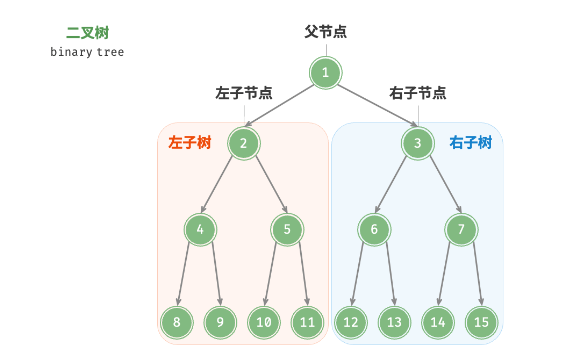
二叉树的结构模拟TS版本。以及它的删除和初始化操作。具体实现如下
class TreeNode {
  val: number;
  left: TreeNode|null;
  right: TreeNode|null;

  constructor(val:number, left:TreeNode, right:TreeNode ){
    this.val = val;
    this.left = left;
    this.right = right;
  }
}
下面是需要掌握的一些术语
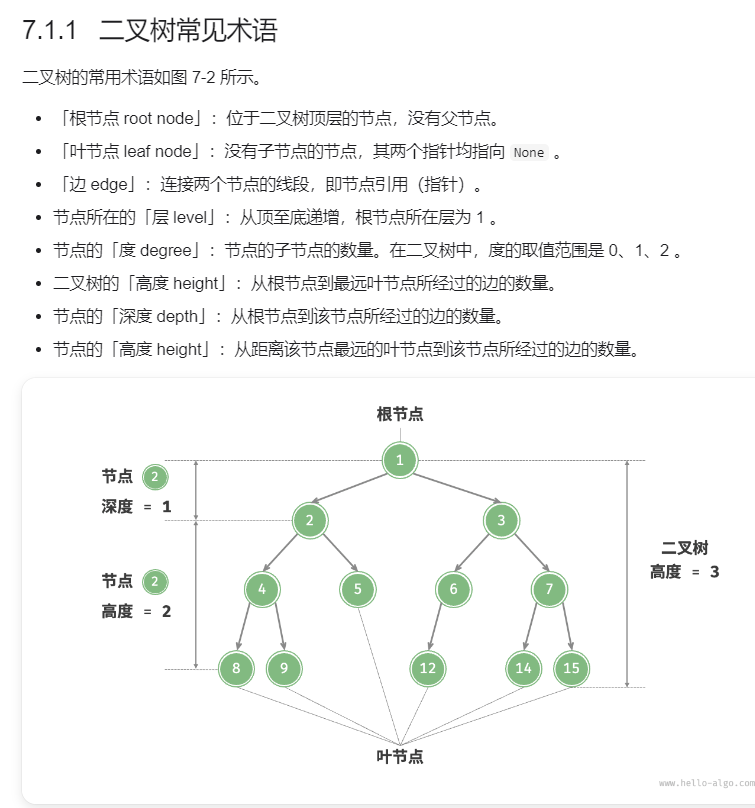
下面是对tree数据结构的操作(主要关注一下)
// 初始化 节点
let n1 = new TreeNode(1);
let n2 = new TreeNode(2);
let n3 = new TreeNode(3);
let n4 = new TreeNode(4);
let n5 = new TreeNode(5);

n1.left = n2;
n1.right = n3;
n2.left = n4;
n2.right = n5;

// 删除节点
const P = new TreeNode(0);
// n1 ->  n2 插入P
n1.left = P;
P.left = n2;

// 删除节点p
n1.left = n2;
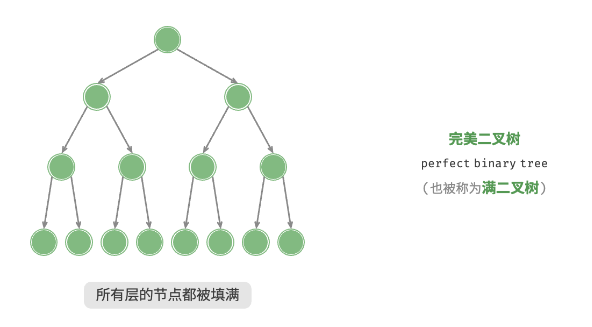
常见的二叉树的类型有下面几种。
- 完美二叉树(满二叉树
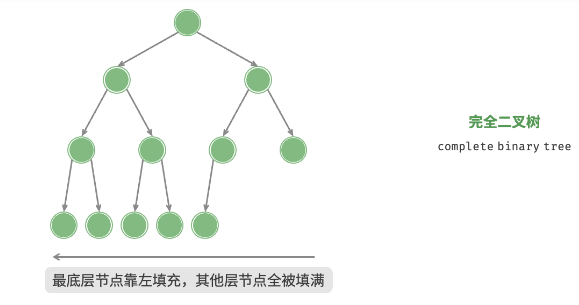
- 完全二叉树 complete binary tree
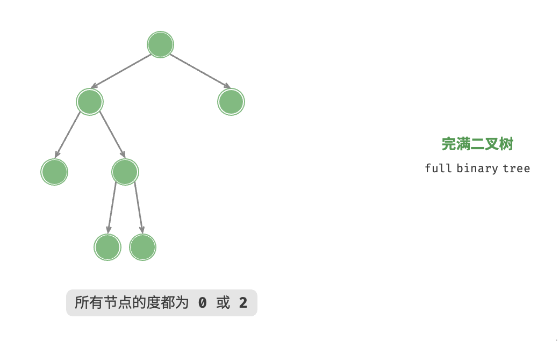
- 完满二叉树 full binary tree
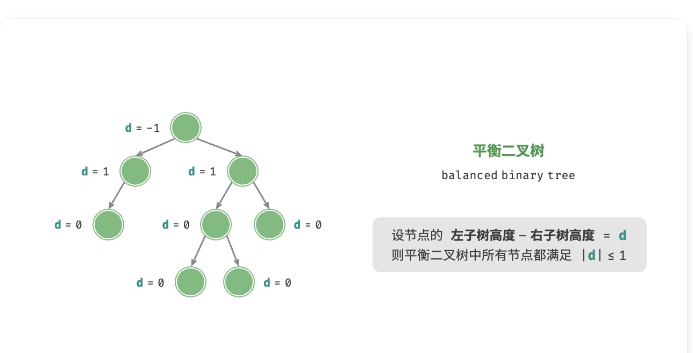
- 平衡二叉树 balanced binary tree
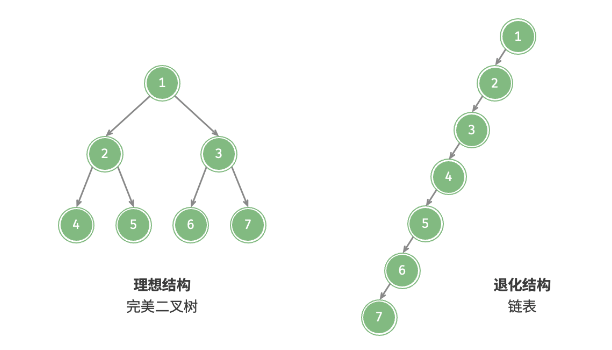
二叉树的退化就变成了一个链表了
关于二叉树的遍历方式,有两种:广度优先/深度优先
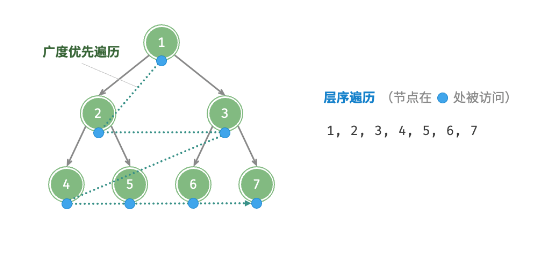
层序遍历 level-order traversal,层序遍历本质上属于「广度优先遍历 breadth-first traversal」,也称「广度优先搜索 breadth-first search, BFS」,它体现了一种“一圈一圈向外扩展”的逐层遍历方式。
下面是它的代码实现
// 广度优先遍历
function levelOrder( root: TreeNode|null ):number[] {
  const queue = [root]
  const list = [];

  while( queue.length ){
    let node = queue.shift();
    if(node.left){
      queue.push(node.left)
    }

    if(node.right){
      queue.push(node.right)
    }
  }

  return list
}
它的复杂度是:
时间复杂度O(n), 空间复杂度O(n)
深度优先搜索 depth-first search, DFS,深度优先遍历就像是绕着整棵二叉树的外围“走”一圈,在每个节点都会遇到三个位置,分别对应前序遍历、中序遍历和后序遍历。,它体现了一种“先走到尽头,再回溯继续”的遍历方式。
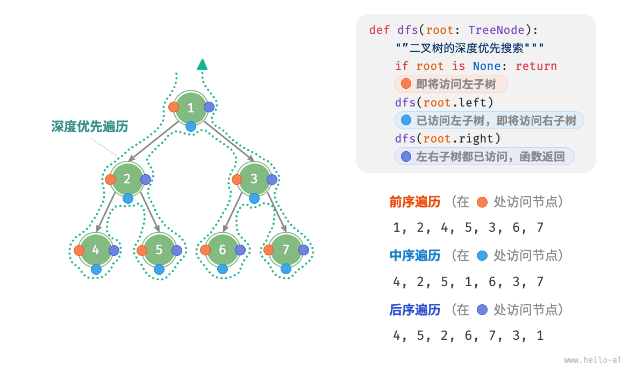
它的遍历代码实现如下:
// 深度优先 核心实现依旧是 递归, 有三种方式 区别在于 先到底的是 左 中 右,

let list = []
// 前序
function preOrder(root: TreeNode | null){
  if(root === null) return;

  // 跟 -> 左 -> 右
  list.push(root.val)
  preOrder(root.left)
  preOrder(root.right)
}

// 中序
function inOrder(root: TreeNode | null){
  if(root === null) return;

  // 左 -> 跟 -> 右
  inOrder(root.left)
  list.push(root.val)
  inOrder(root.right)
}

// 后序
function postOrder(root: TreeNode | null){
  if(root === null) return;

  // 左 -> 右 -> 根
  postOrder(root.left)
  postOrder(root.right)
  list.push(root.val)
}
我们可以使用 Array 来表示和存储 二叉树,当然这有利有弊哈。表示完美二叉树也可以,表示其他的种类的二叉树也可以关键是:“tree的索引和值得映射” 。如果为空的话就用None 值来表示 , 示意图就像下面这样:
这种表示方法中 我们设定这样的一个前置条件 
于是我们就有了完全的 索引 和 val的对应关系
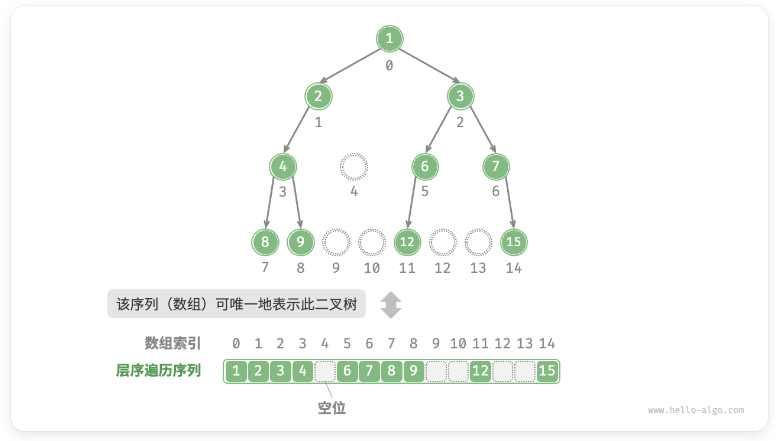
代码实现如下
/* 二叉树的数组表示 */
// 使用 null 来表示空位
let tree: (number | null)[] =
  [1, 2, 3, 4, null, 6, 7, 8, 9, null, null, 12, null, null, 15];
它的一些数据访问操作如下:
// 基于数组的数据
/* 数组表示下的二叉树类 */
class ArrayBinaryTree {
  #tree: (number | null)[];

  /* 构造方法 */
  constructor(arr: (number | null)[]) {
    this.#tree = arr;
  }

  /* 列表容量 */
  size(): number {
    return this.#tree.length;
  }

  /* 获取索引为 i 节点的值 */
  val(i: number): number | null {
    // 若索引越界,则返回 null ,代表空位
    if (i < 0 || i >= this.size()) return null;
    return this.#tree[i];
  }

  /* 获取索引为 i 节点的左子节点的索引 */
  left(i: number): number {
    return 2 * i + 1;
  }

  /* 获取索引为 i 节点的右子节点的索引 */
  right(i: number): number {
    return 2 * i + 2;
  }

  /* 获取索引为 i 节点的父节点的索引 */
  parent(i: number): number {
    return Math.floor((i - 1) / 2); // 向下整除
  }

  /* 层序遍历 */
  levelOrder(): number[] {
    let res = [];
    // 直接遍历数组
    for (let i = 0; i < this.size(); i++) {
      if (this.val(i) !== null) res.push(this.val(i));
    }
    return res;
  }

  // 深度优先遍历 有三种方式
  /* 深度优先遍历 */
  #dfs(i: number, order: string, res: (number | null)[]): void {
    // 若为空位,则返回
    if (this.val(i) === null) return;
    // 前序遍历
    if (order === 'pre') {
      res.push(this.val(i));
    }
    this.#dfs(this.left(i), order, res);
    // 中序遍历
    if (order === 'in') {
      res.push(this.val(i));
    }
    this.#dfs(this.right(i), order, res);
    // 后序遍历
    if (order === 'post') {
      res.push(this.val(i));
    }
  }

  /* 前序遍历 */
  preOrder(): (number | null)[] {
    const res = [];
    this.#dfs(0, 'pre', res);
    return res;
  }

  /* 中序遍历 */
  inOrder(): (number | null)[] {
    const res = [];
    this.#dfs(0, 'in', res);
    return res;
  }

  /* 后序遍历 */
  postOrder(): (number | null)[] {
    const res = [];
    this.#dfs(0, 'post', res);
    return res;
  }
}
二叉搜索树是啥?二叉搜索树的查找操作与二分查找算法的工作原理一致
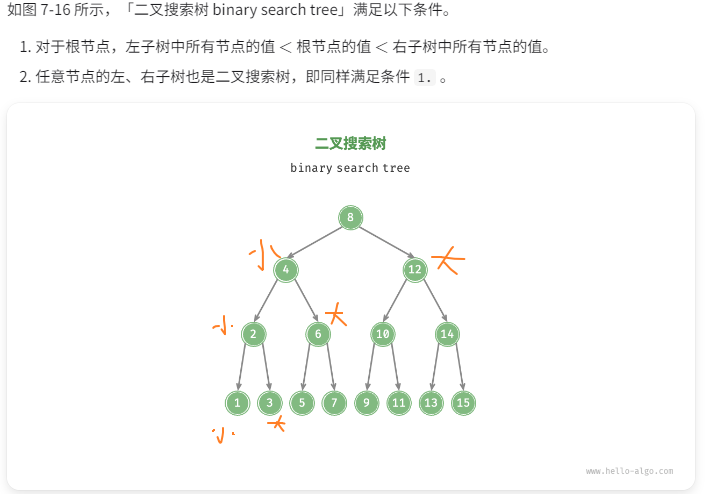
它是一些特性:如何加入节点 , 删除节点,遍历节点,它的效率和应用。(基本上这种类型的Tree是一种高效的Tree结构)
/* 二叉搜索树 */
class BinarySearchTree {
    private root: TreeNode | null;

    /* 构造方法 */
    constructor() {
        // 初始化空树
        this.root = null;
    }

    /* 获取二叉树根节点 */
    getRoot(): TreeNode | null {
        return this.root;
    }

    /* 查找节点 */
    search(num: number): TreeNode | null {
        let cur = this.root;
        // 循环查找,越过叶节点后跳出
        while (cur !== null) {
            // 目标节点在 cur 的右子树中
            if (cur.val < num) cur = cur.right;
            // 目标节点在 cur 的左子树中
            else if (cur.val > num) cur = cur.left;
            // 找到目标节点,跳出循环
            else break;
        }
        // 返回目标节点
        return cur;
    }

    /* 插入节点 */
    insert(num: number): void {
        // 若树为空,则初始化根节点
        if (this.root === null) {
            this.root = new TreeNode(num);
            return;
        }
        let cur: TreeNode | null = this.root,
            pre: TreeNode | null = null;
        // 循环查找,越过叶节点后跳出
        while (cur !== null) {
            // 找到重复节点,直接返回
            if (cur.val === num) return;
            pre = cur;
            // 插入位置在 cur 的右子树中
            if (cur.val < num) cur = cur.right;
            // 插入位置在 cur 的左子树中
            else cur = cur.left;
        }
        // 插入节点
        const node = new TreeNode(num);
        if (pre!.val < num) pre!.right = node;
        else pre!.left = node;
    }

    /* 删除节点 */
    remove(num: number): void {
        // 若树为空,直接提前返回
        if (this.root === null) return;
        let cur: TreeNode | null = this.root,
            pre: TreeNode | null = null;
        // 循环查找,越过叶节点后跳出
        while (cur !== null) {
            // 找到待删除节点,跳出循环
            if (cur.val === num) break;
            pre = cur;
            // 待删除节点在 cur 的右子树中
            if (cur.val < num) cur = cur.right;
            // 待删除节点在 cur 的左子树中
            else cur = cur.left;
        }
        // 若无待删除节点,则直接返回
        if (cur === null) return;
        // 子节点数量 = 0 or 1
        if (cur.left === null || cur.right === null) {
            // 当子节点数量 = 0 / 1 时, child = null / 该子节点
            const child: TreeNode | null =
                cur.left !== null ? cur.left : cur.right;
            // 删除节点 cur
            if (cur !== this.root) {
                if (pre!.left === cur) pre!.left = child;
                else pre!.right = child;
            } else {
                // 若删除节点为根节点,则重新指定根节点
                this.root = child;
            }
        }
        // 子节点数量 = 2
        else {
            // 获取中序遍历中 cur 的下一个节点
            let tmp: TreeNode | null = cur.right;
            while (tmp!.left !== null) {
                tmp = tmp!.left;
            }
            // 递归删除节点 tmp
            this.remove(tmp!.val);
            // 用 tmp 覆盖 cur
            cur.val = tmp!.val;
        }
    }
}

/* Driver Code */
/* 初始化二叉搜索树 */
const bst = new BinarySearchTree();
// 请注意,不同的插入顺序会生成不同的二叉树,该序列可以生成一个完美二叉树
const nums = [8, 4, 12, 2, 6, 10, 14, 1, 3, 5, 7, 9, 11, 13, 15];
for (const num of nums) {
    bst.insert(num);
}
console.log('\n初始化的二叉树为\n');
printTree(bst.getRoot());

/* 查找节点 */
const node = bst.search(7);
console.log(
    '\n查找到的节点对象为 ' + node + ',节点值 = ' + (node ? node.val : 'null')
);

/* 插入节点 */
bst.insert(16);
console.log('\n插入节点 16 后,二叉树为\n');
printTree(bst.getRoot());

/* 删除节点 */
bst.remove(1);
console.log('\n删除节点 1 后,二叉树为\n');
printTree(bst.getRoot());
bst.remove(2);
console.log('\n删除节点 2 后,二叉树为\n');
printTree(bst.getRoot());
bst.remove(4);
console.log('\n删除节点 4 后,二叉树为\n');
printTree(bst.getRoot());

export {};
AVL树(选学)
这是一种特殊的tree 它能够保证 tree不会退化成 链表类型的tree ,导致效率下落到O(n),AVL树 能够让tree的操作效率一直在O(longN). 现在我们深入理解一下 操作的过程和实现的过程。
旋转操作既能保持“二叉搜索树”的性质,也能使树重新变为“平衡二叉树”。
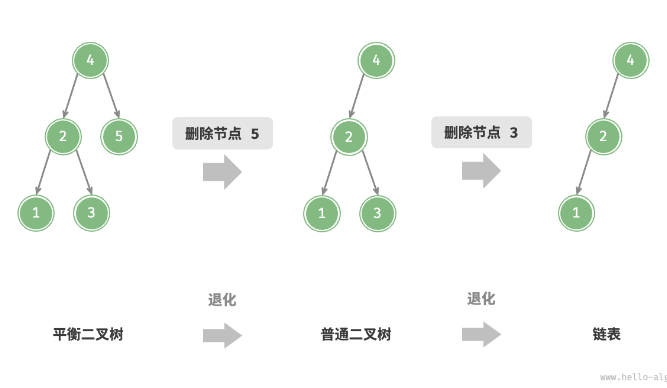
简而言之" 当tree达到一定程度之后,如果发现这个是不平衡的 那么久旋转 以达到操作效率最高化 "
为了实现AVL tree我们需要新增一个 higt 属性 它就是我们这tree的高度
/* AVL 树节点类 */
class TreeNode {
    val; // 节点值
    height; //节点高度
    left; // 左子节点指针
    right; // 右子节点指针
    constructor(val, left, right, height) {
        this.val = val === undefined ? 0 : val;
        this.height = height === undefined ? 0 : height;
        this.left = left === undefined ? null : left;
        this.right = right === undefined ? null : right;
    }

  /* 获取节点高度 */
  height(node) {
      // 空节点高度为 -1 ,叶节点高度为 0
      return node === null ? -1 : node.height;
  }

  /* 更新节点高度 */
  #updateHeight(node) {
      // 节点高度等于最高子树高度 + 1
      node.height =
          Math.max(this.height(node.left), this.height(node.right)) + 1;
  }

  // 节点的「平衡因子 balance factor」定义为节点左子树的高度减去右子树的高度
  /* 获取平衡因子 */
  balanceFactor(node) {
      // 空节点平衡因子为 0
      if (node === null) return 0;
      // 节点平衡因子 = 左子树高度 - 右子树高度
      return this.height(node.left) - this.height(node.right);
  }

  // 下面是左右旋转的过程
  /* 右旋操作 */
  #rightRotate(node) {
      const child = node.left;
      const grandChild = child.right;
      // 以 child 为原点,将 node 向右旋转
      child.right = node;
      node.left = grandChild;
      // 更新节点高度
      this.#updateHeight(node);
      this.#updateHeight(child);
      // 返回旋转后子树的根节点
      return child;
  }

  /* 左旋操作 */
  #leftRotate(node) {
      const child = node.right;
      const grandChild = child.left;
      // 以 child 为原点,将 node 向左旋转
      child.left = node;
      node.right = grandChild;
      // 更新节点高度
      this.#updateHeight(node);
      this.#updateHeight(child);
      // 返回旋转后子树的根节点
      return child;
  }

  /* 执行旋转操作,使该子树重新恢复平衡 */
  #rotate(node) {
      // 获取节点 node 的平衡因子
      const balanceFactor = this.balanceFactor(node);
      // 左偏树
      if (balanceFactor > 1) {
          if (this.balanceFactor(node.left) >= 0) {
              // 右旋
              return this.#rightRotate(node);
          } else {
              // 先左旋后右旋
              node.left = this.#leftRotate(node.left);
              return this.#rightRotate(node);
          }
      }
      // 右偏树
      if (balanceFactor < -1) {
          if (this.balanceFactor(node.right) <= 0) {
              // 左旋
              return this.#leftRotate(node);
          } else {
              // 先右旋后左旋
              node.right = this.#rightRotate(node.right);
              return this.#leftRotate(node);
          }
      }
      // 平衡树,无须旋转,直接返回
      return node;
  }

  // 接下来是它的插入操作
  /* 插入节点 */
  insert(val) {
      this.root = this.#insertHelper(this.root, val);
  }

  /* 递归插入节点(辅助方法) */
  #insertHelper(node, val) {
      if (node === null) return new TreeNode(val);
      /* 1. 查找插入位置并插入节点 */
      if (val < node.val) node.left = this.#insertHelper(node.left, val);
      else if (val > node.val)
          node.right = this.#insertHelper(node.right, val);
      else return node; // 重复节点不插入,直接返回
      this.#updateHeight(node); // 更新节点高度
      /* 2. 执行旋转操作,使该子树重新恢复平衡 */
      node = this.#rotate(node);
      // 返回子树的根节点
      return node;
  }

  // 然后是它的删除节点操作
  /* 删除节点 */
  remove(val) {
      this.root = this.#removeHelper(this.root, val);
  }

  /* 递归删除节点(辅助方法) */
  #removeHelper(node, val) {
      if (node === null) return null;
      /* 1. 查找节点并删除 */
      if (val < node.val) node.left = this.#removeHelper(node.left, val);
      else if (val > node.val)
          node.right = this.#removeHelper(node.right, val);
      else {
          if (node.left === null || node.right === null) {
              const child = node.left !== null ? node.left : node.right;
              // 子节点数量 = 0 ,直接删除 node 并返回
              if (child === null) return null;
              // 子节点数量 = 1 ,直接删除 node
              else node = child;
          } else {
              // 子节点数量 = 2 ,则将中序遍历的下个节点删除,并用该节点替换当前节点
              let temp = node.right;
              while (temp.left !== null) {
                  temp = temp.left;
              }
              node.right = this.#removeHelper(node.right, temp.val);
              node.val = temp.val;
          }
      }
      this.#updateHeight(node); // 更新节点高度
      /* 2. 执行旋转操作,使该子树重新恢复平衡 */
      node = this.#rotate(node);
      // 返回子树的根节点
      return node;
  }
}
堆heap
堆 heap」是一种满足特定条件的完全二叉树,主要可分为两种类型.
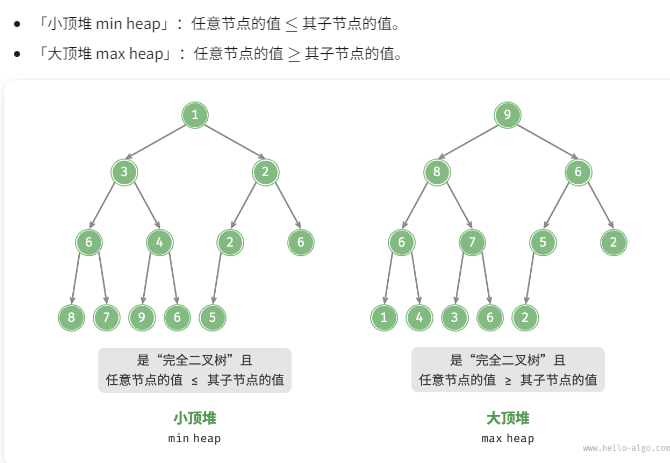
他有一些特性:
- 上层节点会 被填满,底层节点 以此向左填
很多语言有内置的 “优先队列数据结构”,实际上 堆通常用于实现优先队列,大顶堆相当于元素按从大到小的顺序出队的优先队列。从使用角度来看,我们可以将“优先队列”和“堆”看作等价的数据结构。
堆的简单实现,堆顶元素的访问,元素入堆,堆顶元素出堆,“堆化”操作。
通常它的效率是:
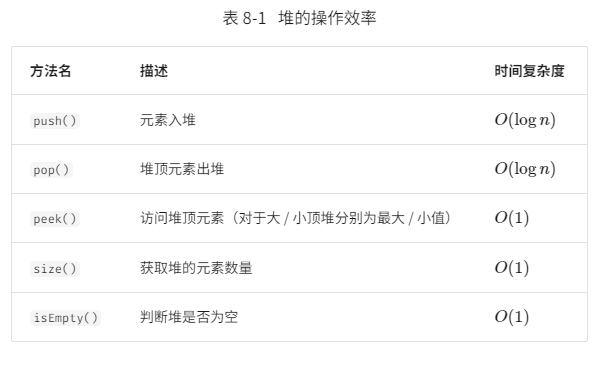
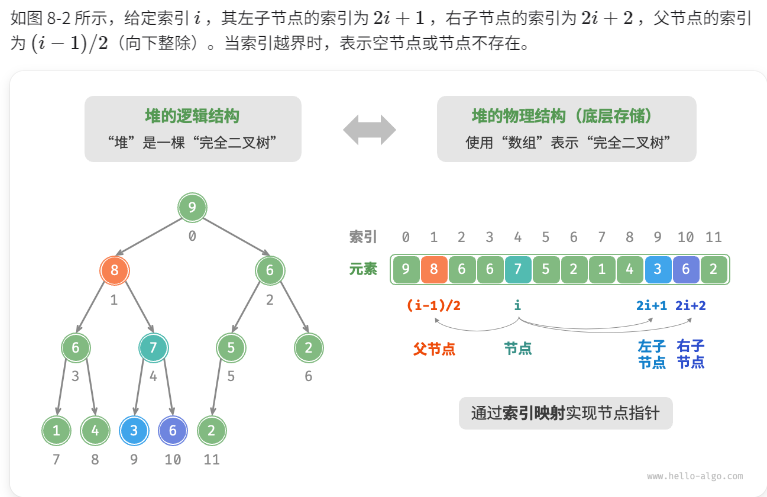
由于 堆就是 完满二叉树的一种,所以我们使用array 来表示,并且给索引设计一套规则
/* 最大堆类 */
class MaxHeap {
    private maxHeap: number[];
    constructor(nums?: number[]) {
    }

    /* 获取左子节点的索引 */
    private left(i: number): number {
        return 2 * i + 1;
    }

    /* 获取右子节点的索引 */
    private right(i: number): number {
        return 2 * i + 2;
    }

    /* 获取父节点的索引 */
    private parent(i: number): number {
        return Math.floor((i - 1) / 2); // 向下整除
    }

    /* 交换元素 */
    private swap(i: number, j: number): void {
        const tmp = this.maxHeap[i];
        this.maxHeap[i] = this.maxHeap[j];
        this.maxHeap[j] = tmp;
    }

    /* 获取堆大小 */
    public size(): number {
        return this.maxHeap.length;
    }

    /* 判断堆是否为空 */
    public isEmpty(): boolean {
        return this.size() === 0;
    }

    /* 访问堆顶元素 */
    public peek(): number {
        return this.maxHeap[0];
    }

    /* 元素入堆 */
    public push(val: number): void {
        // 添加节点
        this.maxHeap.push(val);
        // 从底至顶堆化
        this.siftUp(this.size() - 1);
    }

    /* 从节点 i 开始,从底至顶堆化 */
    private siftUp(i: number): void {
        while (true) {
            // 获取节点 i 的父节点
            const p = this.parent(i);
            // 当“越过根节点”或“节点无须修复”时,结束堆化
            if (p < 0 || this.maxHeap[i] <= this.maxHeap[p]) break;
            // 交换两节点
            this.swap(i, p);
            // 循环向上堆化
            i = p;
        }
    }

    /* 元素出堆 */
    public pop(): number {
        // 判空处理
        if (this.isEmpty()) throw new RangeError('Heap is empty.');
        // 交换根节点与最右叶节点(交换首元素与尾元素)
        this.swap(0, this.size() - 1);
        // 删除节点
        const val = this.maxHeap.pop();
        // 从顶至底堆化
        this.siftDown(0);
        // 返回堆顶元素
        return val;
    }

    /* 从节点 i 开始,从顶至底堆化 */
    private siftDown(i: number): void {
        while (true) {
            // 判断节点 i, l, r 中值最大的节点,记为 ma
            const l = this.left(i),
                r = this.right(i);
            let ma = i;
            if (l < this.size() && this.maxHeap[l] > this.maxHeap[ma]) ma = l;
            if (r < this.size() && this.maxHeap[r] > this.maxHeap[ma]) ma = r;
            // 若节点 i 最大或索引 l, r 越界,则无须继续堆化,跳出
            if (ma === i) break;
            // 交换两节点
            this.swap(i, ma);
            // 循环向下堆化
            i = ma;
        }
    }

    /* 打印堆(二叉树) */
    public print(): void {
        printHeap(this.maxHeap);
    }

    /* 取出堆中元素 */
    public getMaxHeap(): number[] {
        return this.maxHeap;
    }
}

/* Driver Code */
if (require.main === module) {
    /* 初始化大顶堆 */
    const maxHeap = new MaxHeap([9, 8, 6, 6, 7, 5, 2, 1, 4, 3, 6, 2]);
    console.log('\n输入列表并建堆后');
    maxHeap.print();

    /* 获取堆顶元素 */
    let peek = maxHeap.peek();
    console.log(`\n堆顶元素为 ${peek}`);

    /* 元素入堆 */
    const val = 7;
    maxHeap.push(val);
    console.log(`\n元素 ${val} 入堆后`);
    maxHeap.print();

    /* 堆顶元素出堆 */
    peek = maxHeap.pop();
    console.log(`\n堆顶元素 ${peek} 出堆后`);
    maxHeap.print();

    /* 获取堆大小 */
    const size = maxHeap.size();
    console.log(`\n堆元素数量为 ${size}`);

    /* 判断堆是否为空 */
    const isEmpty = maxHeap.isEmpty();
    console.log(`\n堆是否为空 ${isEmpty}`);
}
堆的常见应用
- 优先队列:堆通常作为实现优先队列的首选数据结构,其入队和出队操作的时间复杂度均为 n(longN) 这些操作都非常高效。
- 堆排序:给定一组数据,我们可以用它们建立一个堆,然后不断地执行元素出堆操作,从而得到有序数据。然而,我们通常会使用一种更优雅的方式实现堆排序,详见“堆排序”章节。
- 获取最大的 k 个元素:这是一个经典的算法问题,同时也是一种典型应用,例如选择热度前 10 的新闻作为微博热搜,选取销量前 10 的商品等。
什么是建堆操作?意思是把一个list中的数据拿出来,建立一个堆的过程的称呼. 它的时间复杂度为 O(n) 算是比较高效的了
具体而言就是 ,先把array 原封不动的加入到 heap中。然后再倒叙进行“从顶到底的堆化”操作;每次堆化一个节点之后,以该节点为跟节点的子树就会形成一个合法的子堆。底层的叶子节点由于没有子节点所以它不需要堆化。
下面是完整的代码 补全上文中的 class constructor
/* 构造方法,建立空堆或根据输入列表建堆 */
constructor(nums) {
    // 将列表元素原封不动添加进堆
    this.#maxHeap = nums === undefined ? [] : [...nums];
    // 堆化除叶节点以外的其他所有节点
    for (let i = this.#parent(this.size() - 1); i >= 0; i--) {
        this.#siftDown(i);
    }
}
Top-k问题
给定一个长度为 n 的无序数组 nums ,请返回数组中最大的 k 个元素。
我们可以通过堆 来解决此类问题。下面我们来看看 题目和题解
Q: 给定一个 长度为n 的array ,请找出其中的最大的k 个元素
我们又许多种解决方案
- 直接循环遍历 然后去迭代什么的,但是性能很低 O(n^2)
- 进行排序 然后再取 时间复杂度 O(nLogN)
- 如果采取 堆这种数据结构的话 时间复杂度不会超过O(nLogN), 一般在O(n) 左右
堆的实现 主要是下面的逻辑:
- 初始化一个 小顶堆
- 将数组的前k个 依次加入堆中去
- 从第k+1 个开始 如果当前元素 > 堆 顶,那么就把堆顶 移出去,然后把当前元素加入到堆中去
- 结束之后 堆中就保存了 结果
/* 元素入堆 */
function pushMinHeap(maxHeap: MaxHeap, val: number): void {
    // 元素取反
    maxHeap.push(-val);
}

/* 元素出堆 */
function popMinHeap(maxHeap: MaxHeap): number {
    // 元素取反
    return -maxHeap.pop();
}

/* 访问堆顶元素 */
function peekMinHeap(maxHeap: MaxHeap): number {
    // 元素取反
    return -maxHeap.peek();
}

/* 取出堆中元素 */
function getMinHeap(maxHeap: MaxHeap): number[] {
    // 元素取反
    return maxHeap.getMaxHeap().map((num: number) => -num);
}

/* 基于堆查找数组中最大的 k 个元素 */
function topKHeap(nums: number[], k: number): number[] {
    // 初始化小顶堆
    // 请注意:我们将堆中所有元素取反,从而用大顶堆来模拟小顶堆
    const maxHeap = new MaxHeap([]);
    // 将数组的前 k 个元素入堆
    for (let i = 0; i < k; i++) {
        pushMinHeap(maxHeap, nums[i]);
    }
    // 从第 k+1 个元素开始,保持堆的长度为 k
    for (let i = k; i < nums.length; i++) {
        // 若当前元素大于堆顶元素,则将堆顶元素出堆、当前元素入堆
        if (nums[i] > peekMinHeap(maxHeap)) {
            popMinHeap(maxHeap);
            pushMinHeap(maxHeap, nums[i]);
        }
    }
    // 返回堆中元素
    return getMinHeap(maxHeap);
}

/* Driver Code */
const nums = [1, 7, 6, 3, 2];
const k = 3;
const res = topKHeap(nums, k);
console.log(`最大的 ${k} 个元素为`, res);
图
图啥?
讲一些概念,术语,表示方法,和应用场景
什么是图:
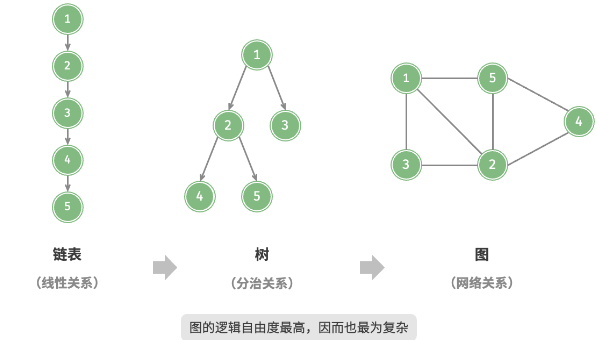
术语和常见概念:有向/无向图,连通/飞连通 图,有权的图。
图的常见术语:领接adjacency,路径path,度degree,
图的表示方法:领接矩阵,领接表,
常见图的应用场景:社交网络,地铁路线....
图的基础操作
有强度,没看懂只能过一遍了
图的遍历
有强度,没看懂只能过一遍了
接下来就是常见的算法讲解了
搜索算法
二分查找
数据的有序性,每伦搜索缩短一半,双指针和区间表示方法。区间表示方法。优点和局限性。(建议实现的时候采取双闭区间的方式 这样出错的概率更小)
二分的插入点
这种算法 还可以实现很多问题的变种,比如“搜索元素插入的位置”。我们分两个类别来看
- 无重复元素的情况
- 有重复元素的情况
二分的边界
查找左右的边界(寻找插入点的本质实际上是查找最左边的一个target的索引)。
查找右边界 有两种取巧的方式。
哈希优化的策略
在算法题目中,我们通常把线性查找替换为Hash查找来降低算法的时间复杂度。
线性查找:以时间换空间
哈希查找:以空间换时间
搜索算法
主要用来在数据结构中,搜索一个/一组满足特定条件的元素。主要有两类思路
- 直接遍历
- 先验证数据结构 如何实现 二分 哈希 和二叉等查找
暴力搜素。自适应搜素。
排序算法
就是对一组数据进行某种规则的排序。它的度量维度有哪些。最理想的排序算法的要求是。
选择排序
选择排序 selection sort,开启一个循环 每伦把最小的找出来放到已排的区间的末尾。此种算法的特性。
冒泡排序
bubble sort,连续的交换相邻元素实现排序。说白了就是先把最大的冒出来,然后不断的冒 直到结束。此种算法的特性。
插入排序
insertion sort,主要的做法是选择一个基准元素 然后再把未排序的与比较,从而实现的算法。此种算法的特性。
快速排序
这是一种基于分治策略的排序算法。此算法的特性。
归并排序
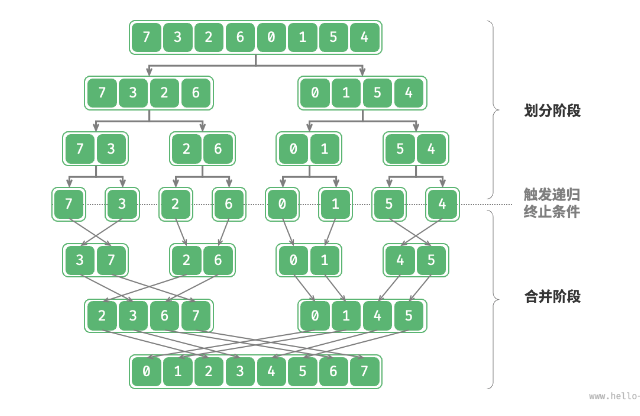
这也是一种基于分治策略的排序算法。此算法的特性。
堆排序
这是一种基于 “堆”数据结构实现的高效排序算法,通过建堆和出堆 完成高效的排序工作。
桶排序
前面提到的几类算法 基本上都是属于“基于比较的排序”,但是桶 这类算法是不属于的。
桶排序的要点是:设置一些有大小顺序的桶 然后分别排序最后合并。
计数排序
通过统计元素数量来实现排序,通常应用于整数数组。此算法的特性。关于计数中的前缀和的含义。
基数排序
「基数排序 radix sort」的核心思想与计数排序一致,也通过统计个数来实现排序。在此基础上,基数排序利用数字各位之间的递进关系,依次对每一位进行排序,从而得到最终的排序结果。
分治
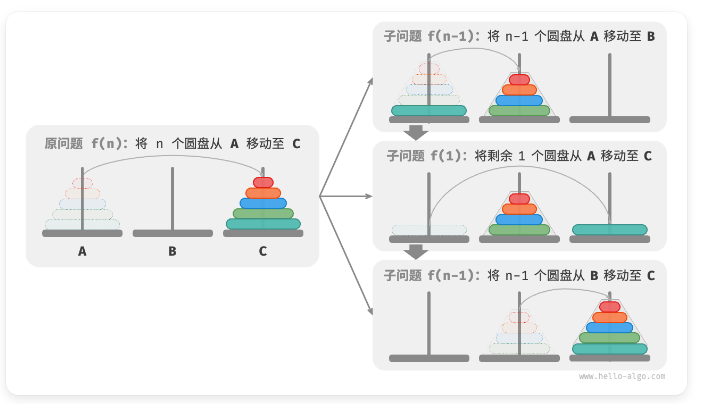
分而治之的算法思想,一般常用在递归的实现中。它分成了 分 和治 两个阶段。
一个问题是否适合使用分治解决 的判断标准
问题可以分解,子问题是独立的,子问题的解可以合并。
它的常见应用。
分支算法和核心在于选取合适的:“分治策略”
分治搜索策略
二分查找实际上就是一个 运用分治思想的典型。下面给出了具体的实现。
构建树问题
有强度,没看明白,仅仅知道使用这种算法可以构建 已知前序/中序 遍历的 树。
汉塔问题
这是一个典型的算法题目
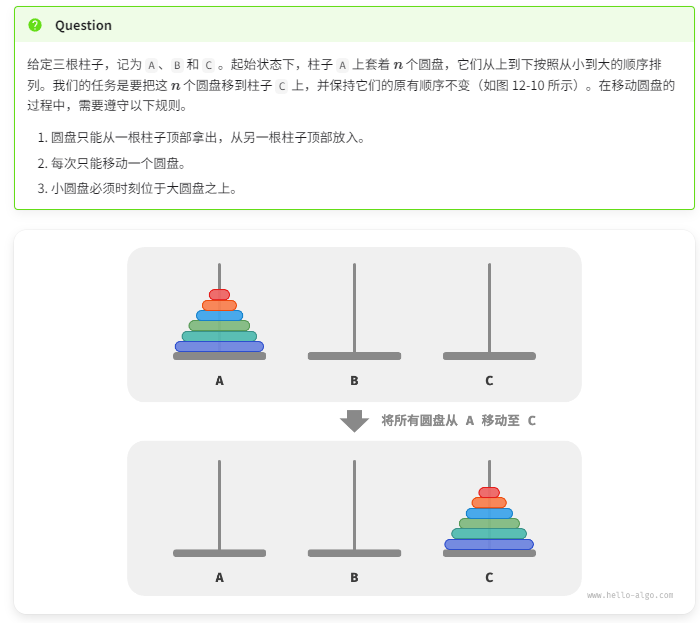
如何运用分治的思想去求解这个问题?
回溯
他是一种通过 穷举的方式 来解决问题的方法。通常用在“深度优先搜素”中。
一个简单的例子。
算法的策略:尝试 和 回退。
优化方法:剪枝 ,和启发式搜索
算法特性:大规模复杂问题 算法效率非常的低。
典型的应用
全排列问题
这是一个非常典型的问题:‘输入一个整数数组,其中不包含重复元素,返回所有可能的排列“。对于它我们就需要用到回溯算法。
解决问题的关键在于:选择合适的剪枝策略。
其算法的复杂度分析
子集问题
着也是一个非常经典的算法问题:
给定一个正整数数组 nums 和一个目标正整数 target ,请找出所有可能的组合,使得组合中的元素和等于 target 。给定数组无重复元素,每个元素可以被选取多次。请以列表形式返回这些组合,列表中不应包含重复组合。
它还有一个变体:“
给定一个正整数数组 nums 和一个目标正整数 target ,请找出所有可能的组合,使得组合中的元素和等于 target 。给定数组可能包含重复元素,每个元素只可被选择一次。请以列表形式返回这些组合,列表中不应包含重复组合。
”
解决这两个问题的关键依然是:“选择合适的剪枝策略。”
N皇后问题
这也是一个经典的问题
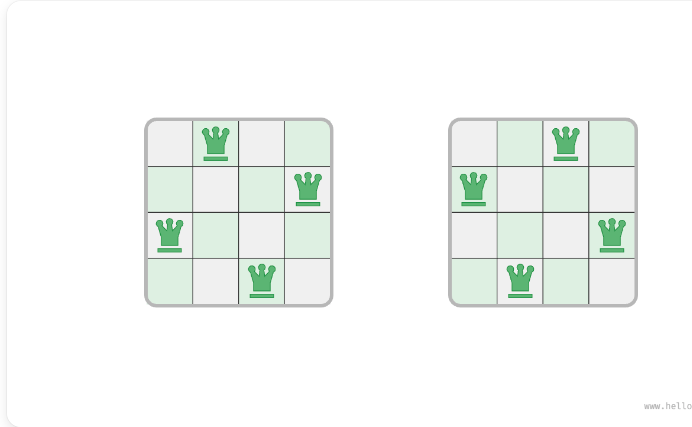
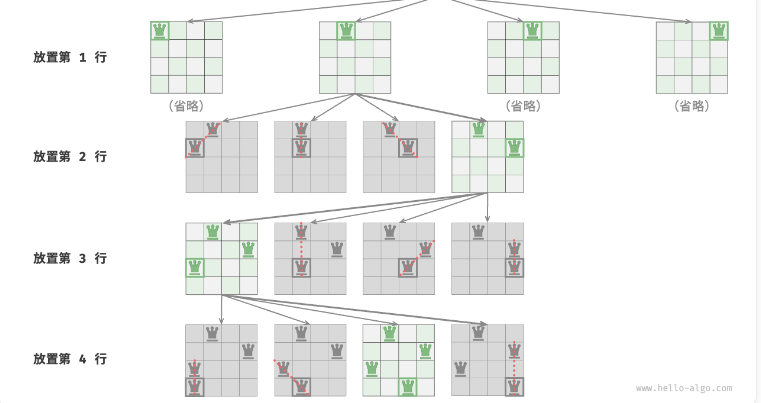
选择合适的剪枝策略 至关重要
贪心算法
初识
「贪心算法 greedy algorithm」是一种解决优化问题的算法,其基本思想是在问题的每个决策阶段,都选择当前看起来最优的选择,即贪心地做出局部最优的决策,以期获得全局最优解。
举个例子:

我们在每轮循环中 总是选择一个最接近它的值 以期达到最优解
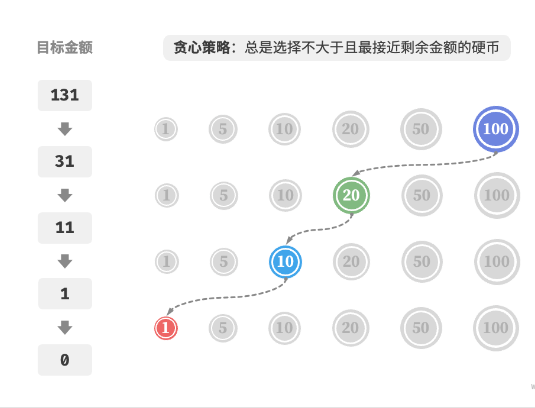
一般而言:贪心适用的情况有下面两种
- 可以保证找到最优解
- 可以找到近视最优解
其算法特性如下:
- 贪心选择性质:只有局部最优解才能导致全局最优解。
- 最优子结构:原始问题的最优解 包含了子问题的最优解
具体的步骤是:
典型的运用是:
背包问题
一个典型的算法问题
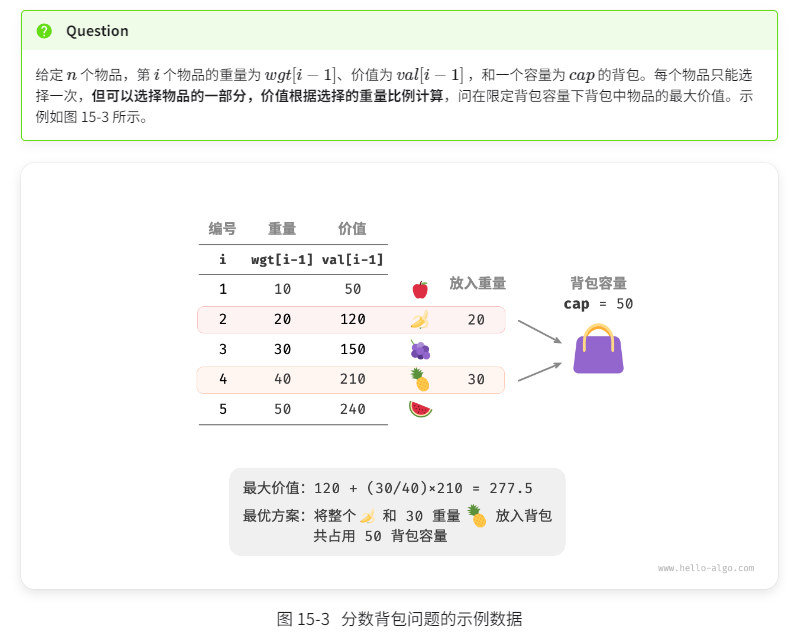
具体的解法:
- 找到问题的关键:单位价值
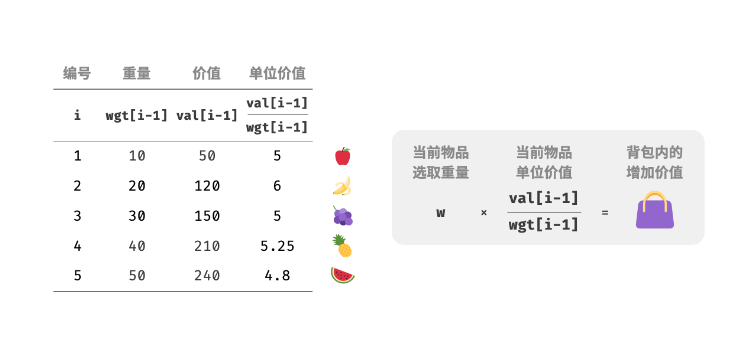
解法:
- 拟定一个贪心策略 (本质上是最大化单位重量下的物品价值)
- 将物品按照单位价值从高到低进行排序。
- 遍历所有物品,每轮贪心地选择单位价值最高的物品。
- 若剩余背包容量不足,则使用当前物品的一部分填满背包
/* 物品 */
class Item {
    w: number; // 物品重量
    v: number; // 物品价值

    constructor(w: number, v: number) {
        this.w = w;
        this.v = v;
    }
}

/* 分数背包:贪心 */
function fractionalKnapsack(wgt: number[], val: number[], cap: number): number {
    // 创建物品列表,包含两个属性:重量、价值
    const items: Item[] = wgt.map((w, i) => new Item(w, val[i]));
    // 按照单位价值 item.v / item.w 从高到低进行排序
    items.sort((a, b) => b.v / b.w - a.v / a.w);
    // 循环贪心选择
    let res = 0;
    for (const item of items) {
        if (item.w <= cap) {
            // 若剩余容量充足,则将当前物品整个装进背包
            res += item.v;
            cap -= item.w;
        } else {
            // 若剩余容量不足,则将当前物品的一部分装进背包
            res += (item.v / item.w) * cap;
            // 已无剩余容量,因此跳出循环
            break;
        }
    }
    return res;
}
最大容量问题
这样是一个在多种面试过程中的一个最常见问题
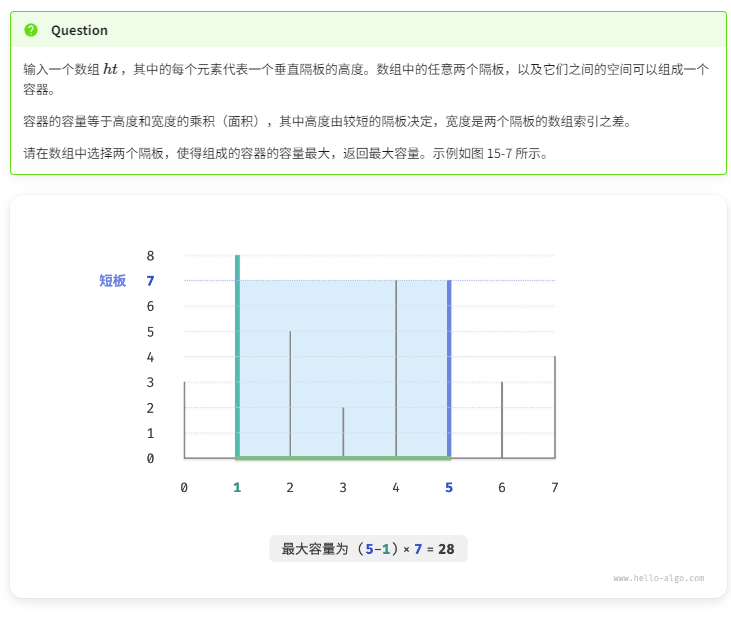
关键是拟定一个 合适的贪心策略
: 初始化两指针,使其分列容器两端,每轮向内收缩短板对应的指针,直至两指针相遇。
解决此问题的过程
- 初始状态下,指针 i 和 j 分列数组两端。
- 计算当前状态的容量 cap[i,j ] ,并更新最大容量。
- 比较板 i和 板 j 的高度,并将短板向内移动一格。
- 循环执行第 2. 步和第 3. 步,直至 i 和 j 相遇时结束。
/* 最大容量:贪心 */
function maxCapacity(ht: number[]): number {
    // 初始化 i, j,使其分列数组两端
    let i = 0,
        j = ht.length - 1;
    // 初始最大容量为 0
    let res = 0;
    // 循环贪心选择,直至两板相遇
    while (i < j) {
        // 更新最大容量
        const cap: number = Math.min(ht[i], ht[j]) * (j - i);
        res = Math.max(res, cap);
        // 向内移动短板
        if (ht[i] < ht[j]) {
            i += 1;
        } else {
            j -= 1;
        }
    }
    return res;
}
最大切分乘积问题
此委托比较的复杂 ,需要多看看
术语
| 中文 | English | 中文 | English |
|---|---|---|---|
| 算法 | algorithm | 层序遍历 | level-order traversal |
| 数据结构 | data structure | 广度优先遍历 | breadth-first traversal |
| 渐近复杂度分析 | asymptotic complexity analysis | 深度优先遍历 | depth-first traversal |
| 时间复杂度 | time complexity | 二叉搜索树 | binary search tree |
| 空间复杂度 | space complexity | 平衡二叉搜索树 | balanced binary search tree |
| 迭代 | iteration | 平衡因子 | balance factor |
| 递归 | recursion | 堆 | heap |
| 尾递归 | tail recursion | 大顶堆 | max heap |
| 递归树 | recursion tree | 小顶堆 | min heap |
| 大 O 记号 | big-O notation | 优先队列 | priority queue |
| 渐近上界 | asymptotic upper bound | 堆化 | heapify |
| 原码 | sign-magnitude | 图 | graph |
| 反码 | 1’s complement | 顶点 | vertex |
| 补码 | 2’s complement | 无向图 | undirected graph |
| 数组 | array | 有向图 | directed graph |
| 索引 | index | 连通图 | connected graph |
| 链表 | linked list | 非连通图 | disconnected graph |
| 链表节点 | linked list node, list node | 有权图 | weighted graph |
| 列表 | list | 邻接 | adjacency |
| 动态数组 | dynamic array | 路径 | path |
| 硬盘 | hard disk | 入度 | in-degree |
| 内存 | random-access memory (RAM) | 出度 | out-degree |
| 缓存 | cache memory | 邻接矩阵 | adjacency matrix |
| 缓存未命中 | cache miss | 邻接表 | adjacency list |
| 缓存命中率 | cache hit rate | 广度优先搜索 | breadth-first search |
| 栈 | stack | 深度优先搜索 | depth-first search |
| 队列 | queue | 二分查找 | binary search |
| 双向队列 | double-ended queue | 搜索算法 | searching algorithm |
| 哈希表 | hash table | 排序算法 | sorting algorithm |
| 桶 | bucket | 选择排序 | selection sort |
| 哈希函数 | hash function | 冒泡排序 | bubble sort |
| 哈希冲突 | hash collision | 插入排序 | insertion sort |
| 负载因子 | load factor | 快速排序 | quick sort |
| 链式地址 | separate chaining | 归并排序 | merge sort |
| 开放寻址 | open addressing | 堆排序 | heap sort |
| 线性探测 | linear probing | 桶排序 | bucket sort |
| 懒删除 | lazy deletion | 计数排序 | counting sort |
| 二叉树 | binary tree | 基数排序 | radix sort |
| 树节点 | tree node | 分治 | divide and conquer |
| 左子节点 | left-child node | 汉诺塔问题 | hanota problem |
| 右子节点 | right-child node | 回溯算法 | backtracking algorithm |
| 父节点 | parent node | 约束 | constraint |
| 左子树 | left subtree | 解 | solution |
| 右子树 | right subtree | 状态 | state |
| 根节点 | root node | 剪枝 | pruning |
| 叶节点 | leaf node | 全排列问题 | permutations problem |
| 边 | edge | 子集和问题 | subset-sum problem |
| 层 | level | n 皇后问题 | n-queens problem |
| 度 | degree | 动态规划 | dynamic programming |
| 高度 | height | 初始状态 | initial state |
| 深度 | depth | 状态转移方程 | state-trasition equation |
| 完美二叉树 | perfect binary tree | 背包问题 | knapsack problem |
| 完全二叉树 | complete binary tree | 编辑距离问题 | edit distance problem |
| 完满二叉树 | full binary tree | 贪心算法 | greedy algorithm |
| 平衡二叉树 | balanced binary tree | ||
| AVL 树 | AVL tree | ||
| 红黑树 | red-black tree |